

A client's legal team sends an email on Friday at 4 PM asking for proof of license on 47 stock images used across three campaigns. Your creative director downloaded them months ago from two different platforms, and the freelancer who picked the hero shots left the project in March. This scenario plays out at agencies every week, and the ones that survive it unscathed are the ones that built transparent license management into their workflow from day one.
Photo by Yan Krukau from Pexels
TL;DR:- Transparent license management means every stock asset your agency uses has a retrievable, shareable proof of license tied to the project it belongs to.
- It prevents legal fire drills, builds measurable client trust, and eliminates the "who downloaded that?" guessing game.
- Clear processes for license documentation reduce audit response time from days to minutes and protect both agency and client from copyright exposure.
Why License Opacity Costs Agencies
Most agencies treat stock licensing like a utility bill: pay the subscription, use the assets, forget about it. That works until it doesn't. A single copyright infringement claim can cost between $750 and $30,000 in statutory damages per image in the United States alone. Multiply that by the hundreds of assets a mid-size agency touches each month, and the risk profile becomes uncomfortable.
The root problem is license opacity. Assets get downloaded by different team members across Shutterstock, Adobe Stock, Envato Elements, iStock, and Freepik. Each platform stores license certificates differently. Some bury them three clicks deep. Others email a PDF that lands in someone's personal inbox. When that person leaves the agency, the proof leaves with them.
Opacity also erodes client trust. When a client asks "do we have the rights to use this image on billboards?" and your answer takes three days, that client starts wondering what else is falling through the cracks.
What Transparent Management Looks Like

Transparent license management is a system where every stock asset used in a project has a corresponding license certificate that is stored centrally, tagged to the project and client, and accessible to anyone who needs it. It has three pillars:
- Centralized storage of all license certificates and purchase records in one location, not scattered across email inboxes, browser downloads folders, and platform dashboards.
- Project-level tagging so that when a client or auditor asks about Campaign X, you pull every license tied to that campaign in seconds.
- Proactive sharing where license documentation is delivered to the client alongside creative assets, not weeks later as a panicked afterthought.
How Agencies Build Clear Processes
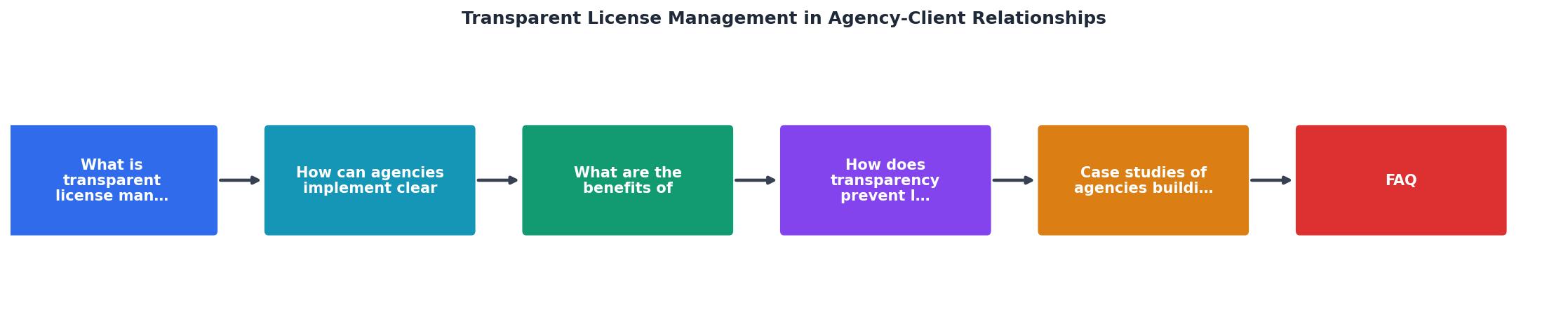
Building a transparent license workflow does not require a six-month IT project. It requires discipline and the right sequence of steps. Here is the process that works, mapped to the diagram above:
- Audit current assets. Catalog every stock platform your team uses. Identify who has login credentials and where downloads happen.
- Centralize certificates. Pull all existing license certificates into a single shared location. Tools like licencedownloader.com let you bulk-download license certificates from multiple platforms, which eliminates the manual hunt across dashboards.
- Tag by project and client. Create a folder structure or tagging system: Client > Project > Asset Type. Every certificate gets filed the moment an asset is downloaded.
- Assign ownership. One person per project is responsible for license documentation. This is usually the producer or project manager, not the designer.
- Deliver with assets. When you hand off final creative files to a client, include a license summary document. This becomes standard deliverable, like a brand guidelines PDF.
- Review on close. At project wrap, verify that every asset has a matching certificate. Flag gaps before the project archive is sealed.
"The Association of National Advertisers (ANA) dropped a bomb on the industry in June of 2016 with the release of a report entitled, "An Independent Study of Media Transparency in the U.S.">, Media Transparency
That report changed how agencies think about financial transparency with clients. License transparency follows the same logic: when clients can see exactly what they are getting and what rights come with it, the relationship strengthens.
Benefits for Agencies and Clients

Transparency is not a one-sided favor to the client. It protects the agency just as much.
For the agency:- Faster audit response. When a client's legal team requests documentation, you respond in minutes instead of days. That speed signals competence.
- Reduced legal exposure. If a copyright troll targets an image your team used, you have the certificate ready. No scrambling, no guessing, no settling out of fear.
- Smoother freelancer transitions. When a contractor finishes their engagement, the license trail stays with the project, not with the person.
- Competitive differentiation. Agencies that include license documentation in their deliverables stand out. It is a tangible proof of professionalism that clients notice during reviews.
- Peace of mind. They know every asset in their campaign is legally covered.
- Easier internal compliance. Large clients have their own legal and procurement teams. Handing them organized license records makes their job easier, which makes them like working with you more.
- Asset reuse confidence. When a client wants to repurpose a campaign image for a new channel, they can check the license scope without calling the agency.
The interactive card below shows how these benefits distribute across a typical agency-client engagement:
Transparency Impact on Agency KPIs
How Transparency Prevents Legal Issues
Stock image copyright claims follow a predictable pattern. A rights holder (or a company acting on their behalf) identifies an image used without a valid license, sends a demand letter, and requests payment. The amounts range from a few hundred dollars to five figures.
Agencies face three common legal scenarios where transparency saves them:
- Expired subscriptions. A team member downloaded an image under a subscription that has since lapsed. The license is still valid for the download date, but only if you can prove the download happened during the active subscription period. A stored certificate with a timestamp is that proof.
- Scope mismatches. A standard license covers web use but not print-on-demand products. If a client repurposes an image beyond its licensed scope, both the client and the agency can face claims. Transparent documentation makes the scope visible before the mistake happens.
- Freelancer downloads. A freelancer uses their personal stock account for agency work. When they leave, the agency has no record of the license. If the freelancer cancels their subscription, the license trail vanishes. Centralizing certificates at the agency level prevents this.
| Opaque License Management | Transparent License Management |
|---|---|
| Certificates in personal inboxes | Centralized, project-tagged archive |
| Days to respond to audits | Minutes to respond to audits |
| Unknown license scope per asset | Scope documented and shared |
| Freelancer departure = lost records | Records stay with the project |
| Reactive legal defense | Proactive legal protection |
Real-World Agency Transparency Wins

Consider a 25-person digital marketing agency running campaigns for eight retail clients simultaneously. Each campaign uses 15 to 40 stock images sourced from Adobe Stock, Shutterstock, and Freepik. That is potentially 320 assets per month.
Before implementing a transparent process, their audit response looked like this: a client's legal team asks for license proof, the account manager emails the creative team, the creative team checks their downloads folders, someone logs into three different platforms, and two days later a partial set of certificates arrives. The client is unimpressed.
After building a centralized license archive with project-level tagging, the same request takes 15 minutes. The account manager opens the project folder, exports the license bundle, and sends it. The client's legal team confirms receipt the same afternoon.
Another scenario: a mid-size branding agency lost a freelance art director who had been downloading assets from their personal Envato Elements account. Three months later, a client received a copyright notice for an image used in packaging. The agency had no license certificate because the proof lived in the freelancer's account. The settlement cost more than a year of the stock subscription. After that incident, the agency mandated that all downloads go through agency-owned accounts and that every certificate is archived immediately using bulk download tools.
Transparent License Management Implementation Checklist
Your progress is saved automatically in your browser.
FAQ
Frequently Asked Questions
Additional Resources
- Full article: Cultivating Effective Agency–Client Relationships - The purpose of this study is to systematize and analyze how the quality of agency–client relationships in public relations can be defined and what dimensions ...
- Maintaining Client Commitment in Advertising Agency– ... - This study also underlines the importance of customer behaviors in advertising agency–client relationships. ... Industrial Marketing Management. (1980).
- Media Transparency - How are agency/client relationships ... - The report was a wake-up call to brands, claiming that non-transparent practices were “pervasive” throughout the advertising agency ecosystem, ...