

A 25-person creative agency was spending over 12 hours per week tracking down stock image licences scattered across six different platforms, three shared accounts, and a rotating roster of freelancers. When a client's legal team requested proof of licence for 40 assets used in a single campaign, the fire drill took two full business days and still came up short on three files. That moment forced a complete rethink of how the agency handled licence compliance, and the centralized approach they adopted cut audit response time from days to under an hour.
Photo by Canva Studio from Pexels
TL;DR:- A mid-sized agency reduced licence audit response time from 2+ days to under 60 minutes by centralizing licence management across all stock platforms.
- The shift eliminated scattered records, removed single-point-of-failure knowledge held by individual team members, and brought compliance rates above 95%.
- Implementing centralized tools required upfront effort in auditing existing assets, selecting the right tooling, and training the team, but the ROI showed within the first quarter.
The Real Problem With Scattered Licences
Most agencies do not start with a licence management problem. They start with a growth problem. The agency in question grew from 8 people to 25 over three years. During that time, individual designers signed up for their own Shutterstock seats. The production team had a shared Adobe Stock account. Freelancers used Freepik and Envato Elements under personal subscriptions and billed the assets back. Nobody planned for this mess. It just happened.
The consequences stacked up:
- Licence certificates lived in email inboxes, browser download folders, and occasionally a shared Google Drive with no naming convention.
- When a designer left, their licence history left with them.
- Client audit requests triggered panic, not process.
- Duplicate purchases happened regularly because nobody could confirm whether an asset was already licensed.
The agency was paying for six different stock platform subscriptions with zero visibility into total spend or licence coverage. That alone justified the project.
What Triggered the Change

The breaking point was a copyright claim. A client received a takedown notice on a social media ad. The image had been licensed, but proving it took four days because the designer who purchased it had left the agency eight months earlier. The licence certificate was buried in a personal email account the agency no longer had access to.
That single incident cost the agency roughly $3,200 in billable hours spent on the investigation, plus a strained client relationship. The operations lead calculated that the agency faced similar (if smaller) fire drills about once per month. The annual cost of disorganized licence management was somewhere between $15,000 and $25,000 in lost productivity alone, not counting the legal risk.
Before centralizing, the team could locate the correct licence certificate on the first attempt only about 35% of the time. The rest required digging through emails, contacting former team members, or re-purchasing the asset entirely.
How the Agency Selected the Right Tools

The operations lead evaluated tools against five criteria:
- Multi-platform support, the tool had to pull licence records from Shutterstock, Adobe Stock, Freepik, Envato Elements, iStock, and Canva. No point centralizing if it only covers two platforms.
- Bulk operations, with 200+ new assets licensed per month, anything requiring manual one-by-one downloads was dead on arrival.
- Team access, multiple team members needed to search and retrieve licences without bottlenecks.
- Audit-ready exports, the output had to satisfy a client legal team, not just an internal checklist.
- Low onboarding friction, designers would ignore anything that added more than two minutes to their workflow.
Tools like Licence Downloader fit this category well. They bulk-pull licence certificates from multiple stock platforms into a single archive, which is exactly the kind of centralization that eliminates the scattered-records problem.
The Implementation Process

Implementation happened in four phases over six weeks. The operations lead deliberately kept each phase short to maintain momentum and avoid the project stalling out.
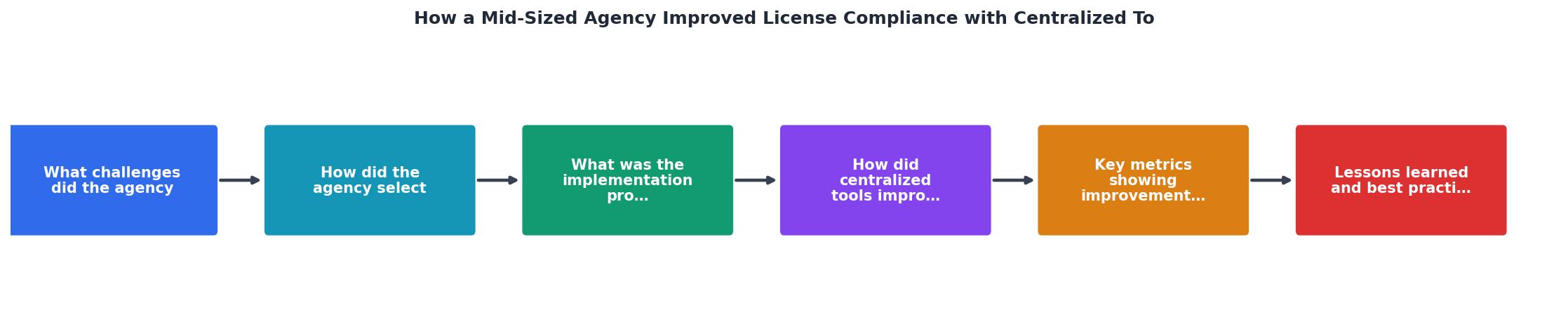
Phase 1: Audit existing assets (Week 1-2). The team catalogued every active project and identified which stock assets were in use. They found 1,847 unique assets across 34 active client projects. About 40% had no retrievable licence certificate on file.
Phase 2: Bulk retrieve historical licences (Week 2-3). Using centralized tooling, the team bulk-downloaded licence certificates from all connected platform accounts. This single step recovered certificates for 92% of the previously undocumented assets.
Phase 3: Establish workflow rules (Week 3-4). New rules were simple: every asset downloaded gets its licence certificate pulled at the same time. Certificates go into a centralized, searchable archive tagged by client, project, and platform. No exceptions.
Phase 4: Train and enforce (Week 4-6). Each team member got a 30-minute walkthrough. The operations lead ran spot checks weekly for the first month. Compliance with the new workflow hit 90% by week three and 98% by week six.
"Configure Proactive Alerts: Set up automated alerts to trigger when license consumption reaches 80% and 95% of your total entitlements.">, 10 Best Practices for Software License Management in 2026
The agency applied this advice by setting up notifications when their Shutterstock and Adobe Stock seat limits approached capacity, preventing surprise overages and unlicensed usage.
Measurable Results After Three Months
The numbers told the story clearly. Here is what the agency tracked during the first quarter after full implementation.
The following dashboard shows the key compliance metrics the agency tracked before and after centralizing their licence management:
Licence Compliance Dashboard
The jump from 35% to 97% licence retrieval success meant the agency could respond to any client audit request with confidence. The two remaining percentage points were edge cases involving assets licensed through freelancer personal accounts before the new policy took effect.
Weekly time spent on licence administration dropped by 87%, from over 12 hours to about 1.5 hours. That freed up the equivalent of a quarter-time employee for actual production work.
Lessons Learned and Best Practices
Six months into the new system, the operations lead documented what worked and what they would do differently.
What worked:- Starting with a full asset audit before selecting tools. Knowing the scope of the problem prevented underestimating the solution.
- Making the new workflow simpler than the old one. Designers adopted it because pulling a licence certificate at download time was faster than hunting for it later.
- Running weekly spot checks during the first month. Gentle accountability built the habit.
- They waited too long to include freelancers in the system. External contributors should be onboarded to the centralized workflow from day one of their contract.
- The initial folder structure was too granular. They simplified from a five-level hierarchy to three levels (client > project > platform) after the first month.
- They should have consolidated platform subscriptions earlier. The audit revealed two redundant Shutterstock seats that had been billing for months with zero usage.
| Before Centralization | After Centralization |
|---|---|
| Licences in 6+ locations | Single searchable archive |
| 35% first-attempt retrieval | 97% first-attempt retrieval |
| 12+ hours/week on admin | 1.5 hours/week on admin |
| ~18 duplicate purchases/month | ~2 duplicate purchases/month |
| Audit response: 2+ days | Audit response: < 1 hour |
| Freelancer licences lost on offboard | Licences retained in central system |
Step-by-Step Implementation Guide
Centralized Licence Management Implementation Checklist
Your progress is saved automatically in your browser.
FAQ
Frequently Asked Questions
Additional Resources
- 10 Best Practices for Software License Management in 2026 - A proactive approach to compliance is a non-negotiable best practice for software license management. This involves conducting systematic, ...
- Strategic Software License Management & Cost Optimization - Optimize software spend by up to 30% with Eracent intelligent license management and optimization solutions. Gain visibility and control over software usage ...
- Understanding Software License Management Solutions ... - How to Achieve Compliance with Software Licenses · Implement a Robust License Management System: · Conduct Regular Internal Audits: · Educate ...