
A creative agency running thirty client accounts across five stock platforms generates hundreds of licensed assets every month. Tracking each licence certificate manually is a compliance nightmare that eats billable hours and still leaves gaps auditors love to find. AI-driven verification tools are changing this equation by automating the tedious parts and flagging risks before they become legal problems.
Photo by Kampus Production from Pexels
TL;DR:- AI automates licence matching, metadata extraction, and compliance checks across platforms like Shutterstock, Adobe Stock, Freepik, and Envato.
- Agencies cut verification time by up to 85% and reduce human error that leads to costly copyright disputes.
- Implementing AI for licence management starts with centralizing your licence data, then layering automated checks on top.
Why Manual Verification Fails at Scale
Every stock platform stores licence proof differently. Shutterstock buries certificates in download history. Adobe Stock ties them to your Creative Cloud account. Freepik generates PDFs you have to request individually. Envato Elements links licences to specific project names. When your agency manages ten or more seats across these platforms, the manual approach collapses under its own weight.
Here is what typically goes wrong:
- Licence certificates get lost when team members leave or switch roles.
- Audit requests turn into fire drills because nobody knows which folder holds which proof.
- Freelancer offboarding creates blind spots where licences exist under personal accounts.
- Version mismatches happen when someone downloads an asset under a standard licence but uses it in a way that requires extended rights.
That number reflects a consistent pattern across the creative industry: most agencies know they have gaps but lack the bandwidth to close them manually.
What AI Brings to Licence Verification

AI does not replace your compliance process. It accelerates the parts that are repetitive, error-prone, and time-consuming. Three core capabilities matter for agencies:
Automated Metadata Extraction
Optical Character Recognition (OCR) and natural language processing scan licence documents, invoices, and confirmation emails to extract key fields: asset ID, licence type, purchase date, permitted usage scope, and expiration. Instead of a human reading each PDF, the system parses hundreds in minutes.
Cross-Platform Matching
AI models match assets used in client deliverables against your licence database. They compare image fingerprints, filenames, and metadata hashes to confirm that every asset in a project folder has a corresponding valid licence. This catches the common scenario where a designer grabs an image from a free trial or personal account instead of the agency's licensed seat.
Anomaly Detection
Machine learning flags unusual patterns: an asset licensed for editorial use appearing in a commercial campaign, a licence that expired before the project launch date, or a single-seat licence used across multiple team members. These are the exact issues that trigger copyright claims.
How AI Verification Works Step by Step
The process from raw asset to verified licence follows a clear pipeline. Here is how it looks in practice:
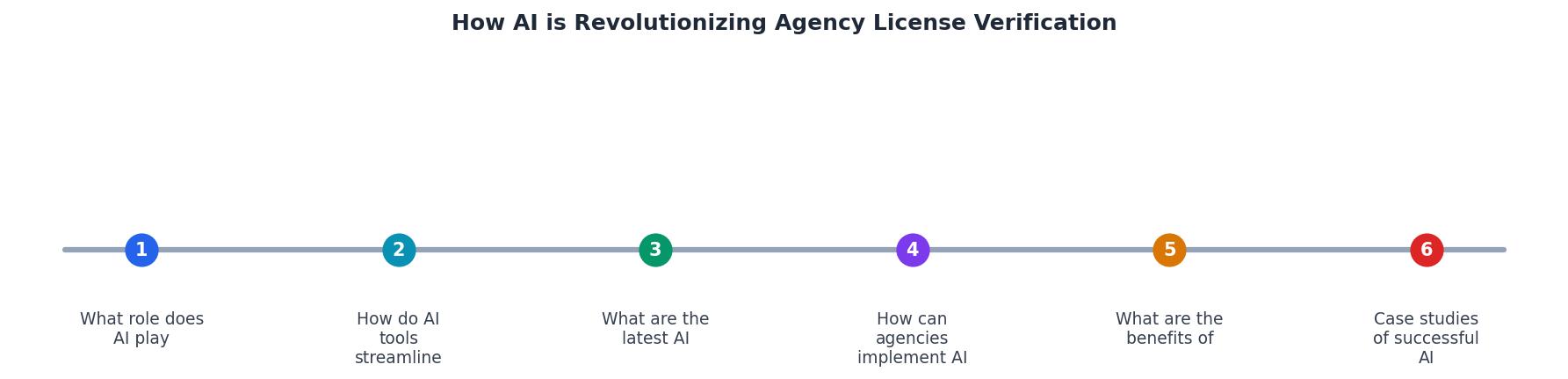
The steps break down as follows:
- Ingest - Collect assets and licence documents from all platforms and team accounts.
- Parse - OCR and NLP extract structured data from certificates, invoices, and emails.
- Match - Image fingerprinting links each asset in your project folders to its licence record.
- Validate - Rules engine checks licence type against actual usage (commercial, editorial, extended).
- Flag - Anomalies surface in a dashboard: missing licences, expired rights, scope mismatches.
- Archive - Verified licence-asset pairs get stored in a centralized, searchable repository.
"Without means to verify an agent's identity and authority, the risks of fraud, unauthorized spending, and compliance failures increase significantly.">, AI agents are poised to revolutionize e
This applies directly to creative agencies. When multiple people download assets under shared accounts, verifying who licensed what and for which project becomes a governance problem that AI solves by maintaining a complete chain of custody.
AI Tools Agencies Use Today

The tooling landscape breaks into three categories:
Platform-Native AI Features
Shutterstock's API now supports automated licence retrieval with metadata tagging. Adobe Stock integrates with Creative Cloud Libraries, where AI can track asset usage across Photoshop and Illustrator files. These built-in features handle single-platform verification well but fall short when your agency uses four or five platforms simultaneously.
Dedicated Licence Management Tools
Tools like Licence Downloader focus specifically on the problem of bulk-finding and downloading licence certificates across multiple stock platforms. Instead of logging into Freepik, Shutterstock, Adobe Stock, Envato, iStock, and Canva separately, you pull all your proof into one place. This centralized approach creates the foundation that AI verification layers need to work effectively.
Custom AI Pipelines
Larger agencies build internal pipelines using cloud vision APIs (Google Cloud Vision, AWS Rekognition) for image fingerprinting combined with document parsing services. This approach offers maximum flexibility but requires engineering resources most mid-size agencies lack.
The following dashboard illustrates how an AI-powered verification system tracks licence status across platforms for a typical mid-size agency handling around 500 assets per month:
AI Licence Verification Dashboard
| Manual Verification | AI-Powered Verification |
|---|---|
| 8-12 min per asset | 1-2 sec per asset |
| Single platform at a time | Cross-platform simultaneous |
| Human error rate ~15% | Error rate under 2% |
| No anomaly detection | Automatic scope mismatch alerts |
| Knowledge lost on turnover | Persistent institutional memory |
| Scales linearly with headcount | Scales with compute, not people |
Implementing AI Verification at Your Agency

Rolling out AI-driven licence verification does not require a six-month IT project. Most agencies can get meaningful results in weeks by following a phased approach.
Phase 1: Centralize Your Licence Data
Before any AI tool can help, you need all your licence certificates in one accessible location. This means:
- Exporting download histories from each stock platform
- Collecting licence PDFs, confirmation emails, and invoice records
- Organizing by client project, not by platform
Phase 2: Set Up Automated Matching
Connect your project management system (or even a structured folder hierarchy) to your licence repository. AI matching tools compare assets in deliverable folders against the licence database. Configure rules for your agency's specific needs:
- Commercial vs. editorial usage boundaries
- Extended licence requirements for print runs above platform thresholds
- Freelancer vs. staff account distinctions
Phase 3: Activate Monitoring and Alerts
Once matching runs continuously, set up alerts for:
- Assets used without a corresponding licence record
- Licences approaching expiration dates
- Usage scope violations (editorial asset in a paid ad, for example)
Phase 4: Build Audit-Ready Reports
Configure automated report generation that produces a complete licence manifest per client project. When a client's legal team asks for documentation, you export a PDF in minutes instead of spending a day digging through email threads.
Real Results from AI Adoption
Agencies that have implemented automated licence verification report consistent improvements:
- Time savings: Teams reclaim 10-15 hours per week previously spent on manual licence tracking.
- Risk reduction: Copyright claim incidents drop because scope mismatches get caught before assets go live.
- Client confidence: Delivering a licence manifest alongside creative work builds trust and differentiates the agency in pitches.
- Onboarding speed: New team members and freelancers plug into the system without needing to learn each platform's licence retrieval process.
AI Licence Verification Integration Guide
Your progress is saved automatically in your browser.
FAQ
Frequently Asked Questions
Additional Resources
- AI for State Regulatory Agencies | Faster Permits, Trusted ... - Learn how state regulatory agencies use AI to speed permit reviews, improve data accuracy, and build public trust using automation and AI ...
- Should some AI agents require a license? The legal and ... - And the same way companies verify our credit card details before the transaction goes through that they can verify that that agent has a license ...
- How to verify AI agents in e-commerce and payments? - AI agents need a fast and trustworthy method to prove their identity and authorization, while businesses need instant verification before ...