
Last quarter a 25-person agency lost three billable days because a client's legal team asked for licence proof on 140 stock assets used across a single campaign. The ops lead dug through six platforms, three ex-freelancer accounts, and a shared Google Drive folder named "licences maybe." That fire drill is exactly the kind of problem AI-driven verification tools now solve in minutes instead of days. If your agency still treats licence management as a manual chore, the gap between you and your competitors is widening fast.
Photo by Tara Winstead from Pexels
TL;DR:- AI automates licence verification across multiple stock platforms, cutting audit-prep time from days to minutes.
- Machine-learning models reduce human error in matching assets to their licence records by over 90%.
- Agencies that adopt AI-assisted licence tools de-risk client relationships and scale content production without scaling legal exposure.
Why Manual Verification Breaks at Scale
A ten-person agency producing 50 assets a month can probably keep up with spreadsheets. A 30-person agency producing 400 assets a month across Shutterstock, Adobe Stock, Envato Elements, iStock, and Freepik cannot. The math stops working.
Manual licence verification involves logging into each platform, locating the download history, cross-referencing asset IDs with project files, exporting PDFs or screenshots, and filing them somewhere retrievable. Multiply that by the number of seats, freelancers, and client projects, and you get a process that eats 15 to 20 hours per month of someone's time.
That time cost is only the visible part. The invisible cost is risk: missed licences, expired subscriptions nobody noticed, assets downloaded under a freelancer's personal account that the agency cannot prove it has rights to use.
AI changes this equation by automating the three hardest parts: asset identification, licence matching, and gap detection.
How AI Automates Licence Matching
The core technology behind AI-driven licence verification combines computer vision, metadata extraction, and natural language processing (NLP). Here is what each layer does:
- Computer vision fingerprints every image, vector, or video frame in your project folders. It creates a unique hash that can be matched against platform download records regardless of cropping, resizing, or format conversion.
- Metadata extraction reads EXIF data, embedded XMP fields, and filename patterns to pull platform-specific asset IDs (e.g., Shutterstock's
SS-prefix or Adobe Stock's numeric identifiers). - NLP parsing scans licence certificates, invoices, and email confirmations to extract licence type, usage scope, expiration dates, and seat assignments.
"The general benefits of implementing AI agents in business include increased productivity, reduced errors, and a more efficient allocation of resources.">, Revolutionizing License Management: How AI Agents are Transforming Software Lice
Reducing Human Error in Licence Records
Human error in licence management falls into predictable categories:
- Wrong licence type recorded. An editor grabs a "Standard" licence screenshot but the asset actually requires an "Extended" licence for the intended use (merchandise, print runs over 500,000).
- Orphaned assets. A freelancer downloads an asset under their personal Envato subscription, delivers the file, and leaves the project. The agency has the file but zero proof of licence.
- Expired subscriptions. A Freepik Premium plan lapses. Assets downloaded during the active period remain licensed, but nobody flags which assets those are versus new downloads that lack coverage.
- Duplicate purchases. Two team members buy the same iStock image on separate seats because neither checked the shared library first.
The Verification Process, Step by Step
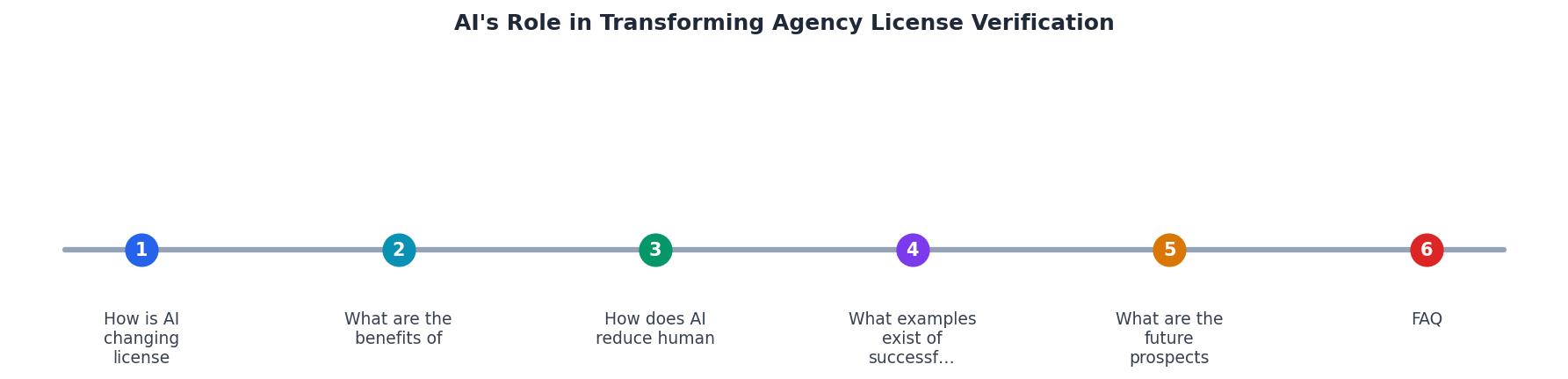
The diagram above shows the five-stage flow most AI-assisted tools follow:
- Scan project folders and cloud storage for all media assets.
- Identify each asset using fingerprinting and metadata extraction.
- Match assets to licence records pulled from connected platform accounts.
- Flag gaps where no licence record exists or the licence type does not cover the intended use.
- Export an audit-ready report with matched certificates, flagged issues, and recommended actions.
The following interactive card illustrates what a typical AI-powered verification dashboard looks like for a mid-size agency running a quarterly audit:
Q2 Licence Audit, Example Agency Dashboard
Real-World Agency Adoption

Agencies across different verticals are integrating AI into their licence workflows:
- Digital marketing agencies with high-volume social campaigns use AI to verify hundreds of stock images per week. One common pattern: a Zapier-style automation triggers a licence check every time a new asset lands in the shared Dropbox folder.
- Branding studios that deliver brand books with 50+ visual assets per client embed licence verification into their delivery checklist. The AI scan runs before the final handoff, and the exported report ships alongside the brand guidelines PDF.
- Video production houses face a trickier challenge because a single project may contain stock footage, music tracks, sound effects, and still images from five or more platforms. AI tools that support multi-format fingerprinting handle this without requiring the editor to manually log each clip.
| Manual Verification | AI-Assisted Verification |
|---|---|
| 15-20 hours/month | 1-2 hours/month |
| Error rate ~12% | Error rate <2% |
| Reactive (audit triggers panic) | Proactive (continuous monitoring) |
| Per-platform login required | Centralized dashboard |
| Freelancer assets often missed | All downloads captured automatically |
What Comes Next for AI and Licensing
The trajectory is clear. Three developments are already in progress:
- Real-time verification at download. Instead of batch-scanning after the fact, AI will verify licence coverage the moment an asset is dragged into a project file. Adobe and Canva are both moving toward tighter integration between their asset libraries and licence records.
- Cross-platform licence consolidation. Right now, each stock platform stores licences in its own format and location. AI-powered aggregators will normalize these into a single, searchable archive. This is exactly the gap that tools like Licence Downloader already address for the certificate-download step.
- Predictive compliance scoring. Machine learning models will assign a risk score to each project based on the number of unverified assets, the licence types in use, and the intended distribution channels. High-risk projects get flagged before they ship, not after a cease-and-desist arrives.
AI Licence Verification Implementation Checklist
Your progress is saved automatically in your browser.
FAQ
Frequently Asked Questions
Additional Resources
- AI for State Regulatory Agencies | Faster Permits, Trusted ... - Learn how state regulatory agencies use AI to speed permit reviews, improve data accuracy, and build public trust using automation and AI ...
- Should some AI agents require a license? The legal and ... - We operate on the blockchain and it will not need anything other than verification. See the thing is that we need to learn to think in more of ...
- Revolutionizing License Management: How AI Agents are ... - This article explores how autonomous AI agents are reshaping the way companies manage and automate software license allocations and renewals.