
A copyright claim lands in your inbox on a Tuesday morning, and suddenly that stock photo you used six months ago threatens to cost you thousands. Freelancers deal with this more often than most people realize, and the services promising to help range from genuinely useful to borderline predatory. This guide breaks down the major copyright claim service categories, explains what each one actually does, and shows you how to protect yourself before a claim ever arrives.
Photo by Miguel Á. Padriñán from Pexels
TL;DR:- Copyright claim services fall into three buckets: enforcement agencies (who send claims), defence/resolution services (who help you respond), and licence management tools (who prevent claims entirely).
- Most freelancers overpay for reactive legal help when proactive licence documentation solves the root problem.
- Your best defence is organized proof of every stock asset licence you hold, stored where you can retrieve it in minutes.
The Freelancer Copyright Problem
Stock images power freelance design work. You download assets from Freepik, Adobe Stock, Shutterstock, Envato, and a dozen other platforms across dozens of client projects every month. Each platform stores licence records differently. Some bury them three clicks deep. Others email a PDF you archived in a folder you forgot about.
Then a claim arrives. A copyright enforcement company says an image on your client's website is unlicensed. You know you paid for it. But proving that takes hours of digging through old accounts, expired email threads, and platform dashboards that changed their UI since you last logged in.
That statistic reflects a real pattern: most freelancers have valid licences but cannot produce proof quickly. And speed matters, because copyright claim services operate on tight response windows.
Three Types of Claim Services

Not all copyright claim services work the same way. Understanding the categories saves you from hiring the wrong kind of help.
1. Enforcement Agencies
These companies work on behalf of copyright holders. They use reverse image search and web crawlers to find unlicensed usage, then send demand letters. Examples include Pixsy, Copytrack, and ImageRights. They typically take a percentage (often 50% or more) of any settlement they recover.
As a freelancer, you are usually on the receiving end of these services. Knowing how they operate helps you respond correctly:
- They send automated detection notices first
- Demand letters follow with a specific dollar amount
- Ignoring them escalates the situation
- Having licence proof often resolves the claim immediately
2. Defence and Resolution Services
These services help you respond to claims. Some are law firms specializing in IP disputes. Others are platforms like LegalShield or specialized copyright attorneys who offer flat-rate consultations. They review the claim, assess its validity, and draft responses.
Costs vary widely:
- Flat-rate consultation: $150 to $500 per claim
- Hourly legal representation: $200 to $600 per hour
- Retainer packages: $1,000 to $5,000 per year
3. Licence Management Tools
These tools prevent claims by keeping your licence documentation organized and accessible. Instead of reacting to a claim, you have proof ready before one arrives. This category includes platform-specific export features, manual spreadsheet tracking, and dedicated tools like Licence Downloader that bulk-download licence certificates across multiple stock platforms.
"According to copyright laws, you can ask them to take it down or negotiate a fee for them to keep it up.">, Guide to Copyright for Freelancers: Who Owns What and Things to Look Out For
Common Mistakes That Cost Money

Freelancers make the same copyright mistakes repeatedly. Here are the ones that actually cost money:
- Paying a claim you do not owe. Enforcement agencies send demand letters for images you legitimately licensed. Without proof handy, some freelancers just pay the $500 to $2,000 demand to make it go away. That is money thrown away.
- Ignoring a valid claim. On the flip side, some freelancers ignore every notice. If the claim is legitimate, ignoring it leads to escalated legal action and higher costs.
- Relying on the client to keep records. You delivered the project. The client published it. The claim arrives at the client, who forwards it to you. If you cannot produce the licence, the client loses trust in you.
- Assuming "free" means "no licence needed." Free stock sites like Unsplash and Pexels still have licence terms. Some restrict commercial use. Some require attribution. Downloading without reading the terms creates exposure.
- Using one platform's asset under another platform's licence. Mixing up which image came from which subscription is surprisingly common when you use three or four stock services.
How to Respond to a Claim

When a copyright claim arrives, follow a clear process. Panic and impulse payments are the enemy.
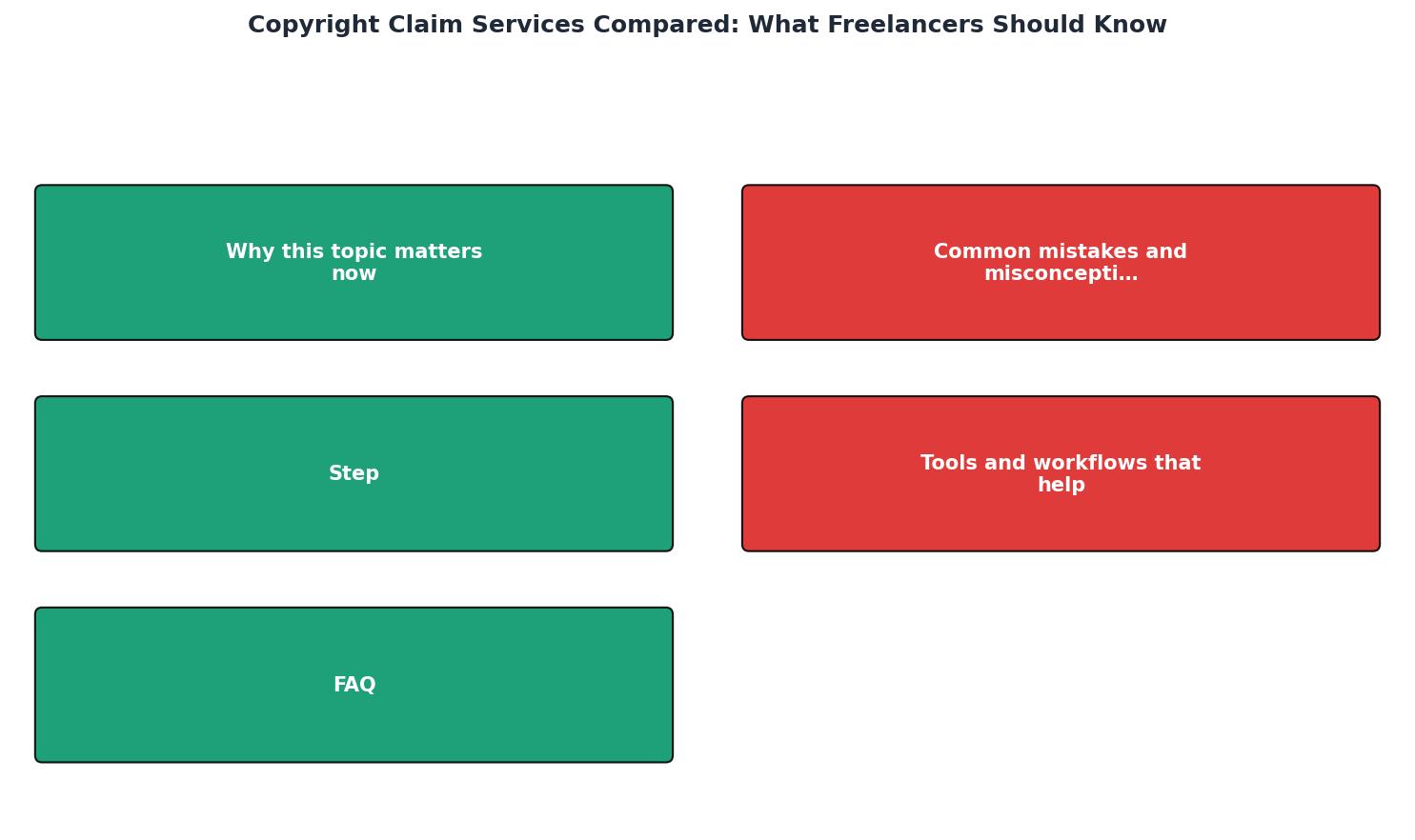
The steps break down like this:
- Read the notice carefully. Identify the specific image, the claimant, and the deadline.
- Check your records. Search your licence certificates, download history, and invoices for the asset in question.
- Verify the claim source. Legitimate enforcement agencies (Pixsy, Copytrack, Getty legal) have verifiable contact information. Scam letters exist.
- Respond with proof. If you hold a valid licence, send the certificate with a brief, professional response.
- Consult a lawyer if needed. If the claim is large, ambiguous, or you cannot find proof, a one-time consultation is worth the cost.
- Document everything. Save every email, every response, every licence file related to the claim.
Comparing Services Side by Side
Here is how the three service categories stack up for a typical freelance designer:
| Feature | Enforcement Agency | Defence Lawyer | Licence Management Tool |
|---|---|---|---|
| When you use it | After a claim (you're the target) | After a claim (you need help) | Before any claim arrives |
| Typical cost | $0 (they bill the other side) | $150-$600 per incident | $0-$50/month |
| Time investment | Hours responding | Hours in consultation | Minutes per month |
| Prevents future claims | No | No | Yes |
| Scales with project volume | No | No | Yes |
The pattern is clear. Reactive services cost more per incident and do nothing to prevent the next one. Proactive licence management costs less and eliminates most claims before they start.
Building Your Licence Defence System
Here is a practical comparison of what a freelancer's licence management setup looks like before and after organizing their records. This example represents a designer working across three stock platforms with roughly 40 asset downloads per month:
Before: No System
After: Organized Records
The difference between these two scenarios is not talent or legal knowledge. It is documentation. A tool like Licence Downloader can bulk-pull licence certificates from Freepik, Shutterstock, Adobe Stock, Envato, iStock, and Canva into one local archive. That turns a 45-minute scavenger hunt into a two-minute file search.
Freelancer Copyright Protection Checklist
Your progress is saved automatically in your browser.
FAQ
Frequently Asked Questions
What is your current system for tracking stock image licences across client projects? Share your approach and any tools that have worked for you.
Additional Resources
- Guide to Copyright for Freelancers: Who Owns What and ... - Learn everything you need to know about your copyright privileges as a freelancer and when you need to define specific terms.
- 5 Copyright Laws Every Freelance Writer Should Know on ... - Just know that as a freelance writer, you automatically own the copyright to your original work the moment you click publish unless you sign a ...
- What Freelancers Need to Know about copyright ownership - Copyright is to create the work: Copyright does not protect ideas! it's very unlikely you have a copyright claim against them. In order to be ...