

A Copytrack claim letter lands in your inbox on a Tuesday morning, demanding hundreds or thousands of dollars for an image your team used on a client project two years ago. You have no idea who downloaded it, which licence covered it, or whether the image was even properly purchased. This guide walks you through exactly how to respond, what evidence to gather, and how to protect your agency from paying settlements you may not owe.
Photo by Cafer Caner Şavli from Pexels
TL;DR:- Copytrack claims are automated copyright infringement notices sent on behalf of photographers. Many are legitimate, but some target properly licensed images.
- Your first move is always to verify the claim, locate your licence proof, and respond in writing within the stated deadline.
- Agencies that keep organized licence archives resolve these claims in days instead of months, often without paying a cent.
Why Copytrack Claims Hit Agencies Hard
Copytrack operates as a copyright enforcement service. Photographers upload their portfolios, Copytrack's crawler scans the web for matches, and automated demand letters go out to anyone using those images without an obvious licence trail. The system does not check whether you actually hold a valid licence before sending the letter.
For agencies, the problem compounds fast. You manage dozens of client projects, each with multiple stock images sourced from Shutterstock, Adobe Stock, Freepik, iStock, or Envato. A single designer might download 50 images in a week. Multiply that across a team of 10 over three years, and you have thousands of assets with licence records scattered across personal accounts, shared logins, email receipts, and platform dashboards that may have changed their UI twice since the original download.
"The victims of this shady enterprise are mostly small businesses and website operators, because they are apparently easier to intimidate and quicker to pay up.">, Copyright Infringement Notice Email from Copytrack
The demand amounts typically range from $200 to $1,500 per image. Agencies that panic and pay immediately often discover later that they held a valid licence all along. The ones that ignore the letter entirely risk escalation to actual legal proceedings.
Common Mistakes When Responding

Agencies make the same errors repeatedly. Knowing them upfront saves you time and money.
- Paying immediately out of fear. The letter sounds threatening. It mentions legal action and statutory damages. But paying before verifying the claim is like pleading guilty before reading the charges.
- Ignoring the letter entirely. Copytrack does escalate. They file lawsuits. Silence is not a strategy.
- Responding emotionally. Angry emails, accusations of extortion, or threats to counter-sue rarely help. Keep communication factual and professional.
- Deleting the image and hoping it goes away. Removing the image from your site does not resolve the claim for past usage. It can also destroy evidence that you used it within licence terms.
- Assuming the freelancer handled it. If a contractor sourced the image, the agency is still the publisher. You need the licence proof in your hands, not a verbal assurance.
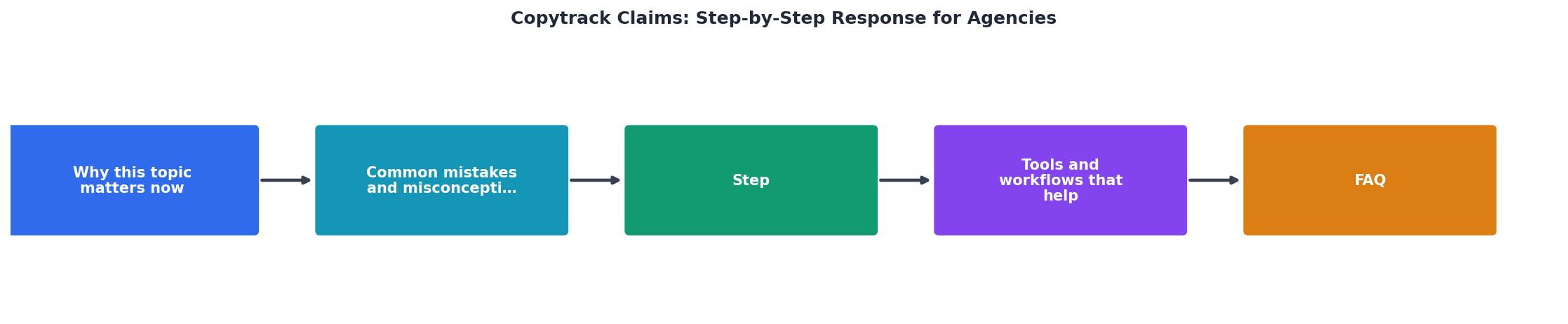
Step-by-Step Response Process
This is the exact sequence your agency should follow when a Copytrack claim arrives.
1. Log the claim details
Record the claim number, the image in question (Copytrack usually includes a thumbnail or URL), the photographer's name, the demanded amount, and the response deadline. Create a dedicated folder for this claim immediately.
2. Verify the image match
Check whether the image on your site actually matches the one Copytrack claims. Reverse image search tools like Google Images or TinEye can confirm or deny the match. Sometimes the crawler flags similar but different images.
3. Locate your licence
This is where most agencies struggle. You need to find the original licence certificate, purchase receipt, or download confirmation from the stock platform where the image was acquired. Check:
- The stock platform's download history (Shutterstock, Adobe Stock, Freepik, etc.)
- Email receipts from the purchase date
- Internal asset management systems or shared drives
- The designer's personal account if they used their own subscription
4. Assess licence validity
Once you have the licence, verify that your usage falls within its terms. A standard licence typically covers web and social media use. Extended licences cover merchandise, large print runs, and resale. If you used a standard-licensed image on a product for sale, the licence may not cover that use even though you paid for the image.
5. Draft your response
If you hold a valid licence, respond to Copytrack with:- A clear statement that you hold a licence for the image
- A copy of the licence certificate or purchase confirmation
- The platform name, purchase date, and licence type
- A request to close the claim
6. Follow up
Copytrack typically responds within 2-4 weeks. If they accept your licence proof, they close the claim. If they dispute it, you may need to involve legal counsel. Keep all correspondence in your claim folder.
Tools and Workflows That Help

Responding to a Copytrack claim is straightforward when you have your licence files ready. The real challenge is building the system that keeps those files organized before a claim ever arrives.
Stock platform dashboards let you view download history, but they vary wildly. Shutterstock keeps detailed records. Freepik buries licence info. Adobe Stock ties licences to your Creative Cloud account. iStock sends email confirmations that get lost in spam folders. None of them make it easy to export everything in bulk.
Shared drives and naming conventions help if your team is disciplined. A folder structure like Client > Project > Assets > Licences works, but only if every designer actually saves the licence file at download time. In practice, this breaks down within weeks.
Licence Downloader at licencedownloader.com solves the bulk retrieval problem directly. It connects to your stock platform accounts and downloads licence certificates in batch, giving you a single archive of proof files organized by platform and date. For agencies handling hundreds of assets per month across multiple platforms, this turns a multi-hour manual process into something that runs in minutes.
| Manual Licence Tracking | Automated with Licence Downloader |
|---|---|
| Search each platform individually | Connect all platforms once |
| Export licences one by one | Bulk download all certificates |
| Hope designers saved receipts | Centralized, searchable archive |
| Hours per audit request | Minutes per audit request |
| Gaps when staff leave | Records persist regardless of turnover |
Building a Claim-Proof Archive

Prevention beats response every time. Here is what a claim-proof licence archive looks like in practice.
One central location. Whether it is a cloud drive, a DAM system, or a dedicated folder on your server, every licence file lives in one place. No exceptions.
Consistent file naming. Use a pattern like platform_imageid_date_licencetype.pdf. When a Copytrack claim references image ID 12345678, you can search your archive and find the matching licence in seconds.
Monthly audits. Once a month, run a quick check: are all images downloaded this month accounted for with licence files? Catching gaps early is infinitely cheaper than reconstructing records two years later.
Freelancer onboarding rules. If contractors source images on their own accounts, require them to submit licence certificates with every deliverable. Make it a line item in your contract.
The following interactive card shows what a well-organized agency claim response dashboard might look like when tracking active Copytrack claims:
Agency Claim Response Tracker
Copytrack Claim Response Checklist for Agencies
Your progress is saved automatically in your browser.
FAQ
Frequently Asked Questions
Additional Resources
- Copyright Infringement Notice Email from Copytrack - From a legal perspective, it is clear that COPYTRACK cannot enforce any claims via email without representation from a state-accredited U.S. lawyer who holds a ...
- Copytrack Copyright Emails: What Councils Need to Know - This updated guidance explains what's happening, why these claims can be misleading, and the simple steps councils can take to respond ...
- FAQ | COPYTRACK Legal Enforcement Services - You are free to seek legal advice before responding. we are unable to process any refunds, We specialize in legal enforcement of claims and protecting media ...