
A single unlicensed stock image buried in a client deliverable can trigger a five-figure copyright claim, and the designer who downloaded it left the agency two years ago. Nobody remembers where the asset came from, nobody can find a licence certificate, and the client's legal team wants answers by Friday. Agencies that invest in license compliance education avoid these fire drills entirely and build a culture where every team member treats licence records as seriously as timesheets.
Photo by Pavel Danilyuk from Pexels
TL;DR:- License compliance education reduces legal risk, speeds up audit responses, and protects client relationships.
- Effective programs combine onboarding training, quarterly workshops, internal reference docs, and tooling like Licence Downloader for bulk proof retrieval.
- Agencies that measure compliance knowledge through spot checks and audit-readiness drills see measurable drops in unlicensed asset usage within six months.
Stock licence compliance is not a legal department problem. It is an operational problem that touches every person who downloads, places, or exports a creative asset. When a junior designer grabs an image from Freepik without saving the licence certificate, or a freelancer uses their personal Shutterstock account for agency work and then leaves, the gap in documentation becomes the agency's liability. Education closes that gap before it opens.
The agencies that handle this well do not rely on a single compliance officer sending reminder emails. They build repeatable systems: short onboarding modules, quarterly refreshers, clear internal wikis, and automated tooling that makes the right behaviour the easy behaviour. The rest of this article breaks down exactly how to build that system.
Why License Education Matters

Most agencies have some form of brand guidelines document. Very few have an equivalent document for licence compliance. The result is predictable: team members make assumptions, and those assumptions diverge.
Here is what goes wrong without structured education:
- Designers assume "paid subscription = unlimited use." They do not check whether a specific licence covers print, web, or resale.
- Account managers promise clients full ownership of assets without verifying the licence type (standard vs. extended).
- Freelancers use personal accounts for agency projects, and when they leave, the licence trail disappears with them.
- Nobody archives licence certificates, so audit requests become multi-day scavenger hunts across Shutterstock, Adobe Stock, Envato, iStock, and Canva dashboards.
Strategies That Actually Work

Telling people "be compliant" accomplishes nothing. Effective education programs give people specific knowledge, clear processes, and tools that reduce friction. Here are the strategies that produce results.
Onboarding Training Module
Every new hire and every new freelancer contractor should complete a 30-minute licence compliance onboarding module before they touch a single asset. This module covers:
- Which stock platforms the agency uses and which accounts to use (never personal ones).
- How to identify licence types: Standard, Extended, Editorial-only, and Free with attribution.
- Where to save licence certificates after every download.
- What to do when a client provides assets without licence documentation.
Quarterly Compliance Workshops
A 45-minute workshop every quarter keeps compliance top of mind. Structure each session around a real scenario:
- Q1: Walk through a mock audit. Pick 10 random assets from recent projects and see if the team can produce licence proof within 15 minutes.
- Q2: Review any near-misses or actual compliance issues from the past quarter.
- Q3: Cover platform updates. Stock platforms change their licence terms regularly. Envato Elements, for example, updated its licence scope in recent years.
- Q4: Bring in an external IP attorney for a 20-minute Q&A. The cost is minimal and the credibility boost is significant.
Internal Compliance Wiki
Create a single internal page (Notion, Confluence, or even a shared Google Doc) that answers the five questions people actually ask:
- Which account do I use for [platform name]?
- Where do I save the licence certificate?
- What licence type do I need for [use case]?
- What do I do if a client sends me an image without a licence?
- Who do I contact if I get a copyright notice?
"Most licenses and certifications have expiration dates, training modules require periodic renewal, and regulatory expectations continue to evolve.">, Why Training Compliance and Licensing Compliance Go Hand
Building an Education Program Step by Step
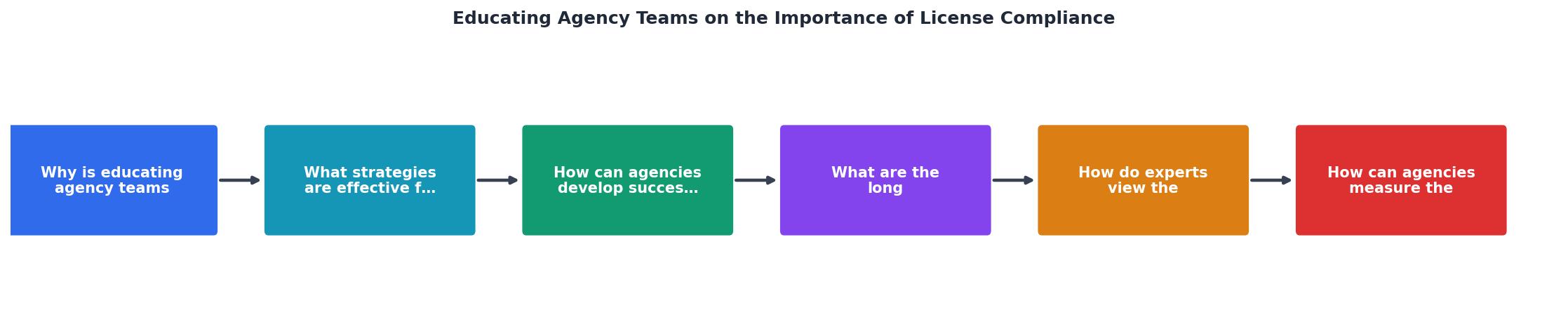
The diagram above outlines the core flow. Here is how to execute each step:
- Audit current state - Inventory every stock platform your agency uses. Count active seats. Identify who has access. Check if licence certificates exist for the last 50 assets used.
- Define policies - Write down the rules. Which platforms are approved? Where are certificates stored? What licence types are required for which deliverables?
- Create training materials - Build the onboarding module and the internal wiki. Record a 10-minute screen-share video walking through the download-and-archive process for each platform.
- Deliver initial training - Run the first workshop for the entire team. Make attendance mandatory.
- Automate where possible - Use Licence Downloader to bulk-retrieve licence certificates from Freepik, Shutterstock, Adobe Stock, Envato, iStock, and Canva. This eliminates the manual step that most people skip.
- Review and iterate - After each quarter, review compliance metrics and update training materials.
Long-Term Impact of Compliance Education

Agencies that run structured compliance education programs for at least two quarters report consistent improvements:
- Audit response time drops from days to hours. When every project folder contains licence certificates, responding to a client's legal team is a file-share operation, not a research project.
- Copyright claims decrease. Teams that understand licence scope stop using editorial-only images in commercial campaigns and stop exceeding print run limits on standard licences.
- Freelancer onboarding gets faster. A clear compliance module means contractors are productive on day one without creating risk.
- Client trust increases. Proactively sharing licence documentation with deliverables signals professionalism. Some agencies now include a "licence compliance package" as a standard deliverable.
The compounding effect matters. Each quarter of consistent education builds institutional knowledge that survives staff turnover. The agency's compliance posture becomes a property of the organization, not of individual employees.
Measuring Education Program Success
You cannot improve what you do not measure. Here are the metrics that matter for a compliance education program:
The following dashboard shows example metrics for a mid-size agency (25 people) six months into a compliance education program:
Compliance Education Dashboard (6-Month Snapshot)
Key Metrics to Track
- Onboarding completion rate - Percentage of new hires/contractors who finish the compliance module before their first project. Target: 100%.
- Spot-check pass rate - Pick 5 random assets from recent projects monthly. Can the team produce licence proof within 10 minutes? Track the percentage over time.
- Audit response time - Measure how long it takes to compile full licence documentation for a client request. Benchmark before and after training.
- Copyright claim frequency - Track the number of claims or takedown notices per quarter. A downward trend validates the program.
- Workshop attendance - If attendance drops below 80%, the program needs a format refresh.
| Before Education Program | After Education Program |
|---|---|
| 18-hour average audit response | 2-hour average audit response |
| No standard onboarding process | 96% onboarding completion |
| Licence proof for ~30% of assets | Licence proof for 91% of assets |
| 5 copyright claims per 6 months | 1 copyright claim per 6 months |
| Freelancers use personal accounts | All work through agency accounts |
Agency Compliance Education Program Planner
Your progress is saved automatically in your browser.
FAQ
Frequently Asked Questions
Additional Resources
- Why Training Compliance and Licensing ... - By linking employee training data with licensing status, organizations can quickly spot gaps, take corrective action, and demonstrate a culture ...
- Insurance Agency Licensing, Exam Readiness & Compliance - Learn how insurance agencies improve licensing, exam readiness, onboarding visibility, and compliance through centralized operational oversight.
- Guide: Agency License Management - Agency license management software automates license tracking, renewals, and education credits, sending reminders and reports to help agents stay compliant.