
Stock media licensing is changing fast, and freelancers who ignore the shifts risk compliance headaches, lost clients, and unexpected legal bills. Platforms are rewriting their licence terms, AI tools are entering the compliance space, and subscription models keep fragmenting. This article breaks down the specific trends heading your way and gives you a concrete roadmap to stay ahead of every one of them.
Photo by Beyzanur K. from Pexels
TL;DR:- AI-driven licence management tools will automate compliance checks, metadata tagging, and certificate retrieval across platforms like Freepik, Adobe Stock, and Shutterstock.
- Subscription licensing models are fragmenting into tiered, usage-based, and project-scoped structures that demand closer tracking.
- Freelancers who build a licence audit habit now will avoid costly disputes and look more professional to clients requesting proof of use.
What is actually changing?
Freelance designers juggle three, four, sometimes five stock platforms at once. Each platform stores licence certificates differently, updates terms on its own schedule, and buries proof-of-purchase behind different menus. That friction used to be annoying. Now it is becoming risky.
Three forces are converging. First, clients and their legal teams ask for licence documentation more often than they did two years ago. Second, platforms are experimenting with new licence structures that go beyond the classic "standard vs. extended" split. Third, AI-powered tools are making it possible to automate what used to be a manual, platform-by-platform scavenger hunt.
The result: freelancers who treat licence management as an afterthought will spend more time firefighting. Those who adapt early will save hours every month and close client trust gaps before they open.
How AI reshapes licence management

AI is not replacing the creative work. It is replacing the boring admin around it. Here is what that looks like in practice for licence management:
- Automated certificate retrieval. Instead of logging into Freepik, Adobe Stock, and Envato separately, tools like Licence Downloader can bulk-find and download licence certificates across platforms in one pass.
- Metadata matching. AI can cross-reference the asset IDs in your project files against your licence records, flagging any image that lacks a matching certificate.
- Expiry and renewal alerts. Subscription-based licences sometimes expire when a plan lapses. AI monitoring catches those gaps before a client audit does.
- Natural language search. Instead of remembering an asset number, you describe the image ("blue gradient background used in Acme Corp deck") and the system locates the licence.
"Most creators have at least a little familiarity with licensing things.">, What Every Creator Should Know About Video Licensing
That familiarity is a starting point, not a finish line. AI tools close the gap between "I know I should track licences" and "I actually have every certificate filed and searchable."
Licensing models are fragmenting

The old world was simple: buy a standard licence for web use, buy an extended licence for merchandise. That world is shrinking. Here is what platforms are moving toward:
- Usage-based tiers. Shutterstock and iStock already differentiate pricing by impression count and distribution channel. Expect more platforms to adopt this.
- Project-scoped licences. Some platforms now tie a licence to a specific project or client. If you reuse the asset elsewhere, you need a second licence.
- AI-generated content licences. Adobe Firefly, Shutterstock's AI generator, and Canva's text-to-image tools each have their own licence terms for AI-created assets. These terms are still evolving and differ significantly from traditional stock licences.
- Subscription-dependent validity. On Envato Elements and Canva Pro, your licence to use downloaded assets can depend on maintaining an active subscription. Cancel, and some usage rights narrow.
| Traditional Model | Emerging Model |
|---|---|
| Standard vs. Extended | Tiered by usage volume |
| Perpetual after purchase | Subscription-dependent validity |
| Platform-agnostic terms | Platform-specific AI content clauses |
| One licence per asset | Project-scoped or client-scoped |
This fragmentation means a single freelancer might operate under four or five different licence frameworks simultaneously. Tracking which rules apply to which asset is no longer optional busywork. It is a core professional skill.
Digital rights management gets personal

Digital rights management (DRM) used to be a concern for big publishers and music labels. For freelancers, it is becoming personal. Here is why:
- Copyright claim bots are getting smarter. Automated systems scan social media, ad platforms, and e-commerce listings for unlicensed images. A missing certificate can trigger a takedown or a demand letter even when you did pay for the asset.
- Platform takedowns affect your client, not just you. If a Facebook ad gets flagged for a copyright issue, the client's ad account takes the hit. That blowback lands on the freelancer who sourced the image.
- Blockchain-based provenance tracking is being tested by several stock platforms. The idea: every licence transaction gets an immutable record. Early implementations are clunky, but the direction is clear.
The practical takeaway: keep your licence certificates organized, searchable, and shareable. When a claim bot flags an asset, the freelancer who can produce a certificate in five minutes wins. The one who spends two days digging through email receipts loses the client.
A roadmap for adapting
Here is the process for staying ahead of these changes, broken into concrete steps:
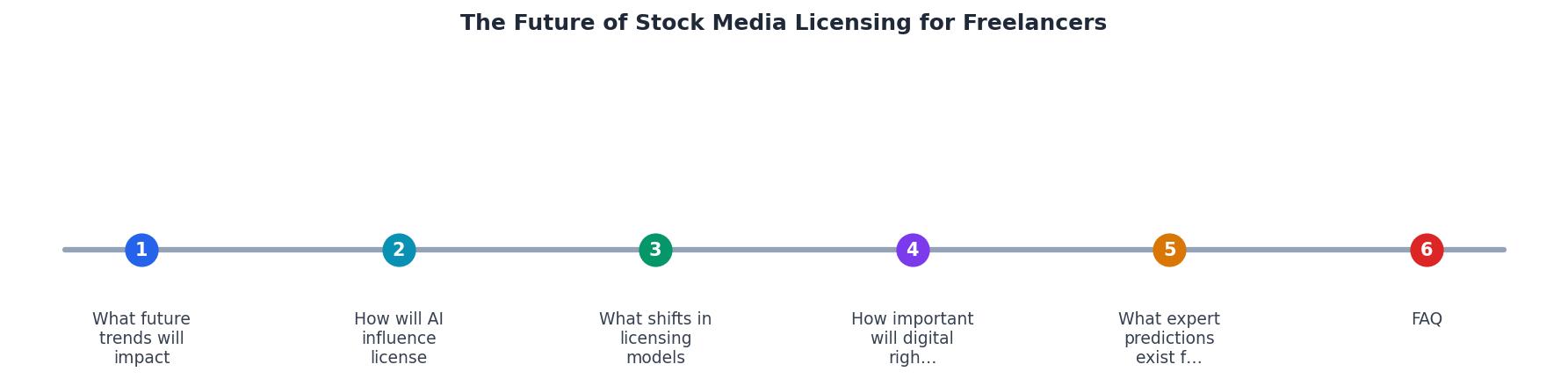
The diagram shows five steps: Audit your current licences, Centralize certificates in one location, Automate retrieval with a tool, Monitor for term changes, and Share proof with clients. Each step feeds the next, creating a loop you revisit quarterly.
Here is what each step looks like in practice:
- Audit. Log into every stock platform you use. Export your download history. Note which assets lack a matching licence certificate.
- Centralize. Pick one storage location: a cloud folder, a project management tool, or a dedicated licence management app. Every certificate goes there.
- Automate. Use a bulk retrieval tool like Licence Downloader to pull certificates across Freepik, Shutterstock, Adobe Stock, Envato, iStock, and Canva in one session instead of five.
- Monitor. Set a calendar reminder to review platform term updates quarterly. Platforms like Envato and Canva update their licence terms more often than you might expect.
- Share. Build a standard deliverable packet for clients that includes a licence summary alongside the creative files. This takes five minutes and prevents weeks of back-and-forth later.
The following interactive card summarizes what a well-organized freelancer's licence dashboard might look like after completing these five steps. This example represents a typical designer managing three active platform subscriptions with around 50 assets per month:
Licence Compliance Dashboard
Expert predictions for the licensing landscape
Industry analysts and platform insiders point to several developments freelancers should watch:
- Unified licence standards. There is growing pressure from creator communities for platforms to adopt a shared licence metadata format. If this happens, cross-platform compliance tools become dramatically simpler.
- Embedded licence data in files. Some platforms are experimenting with embedding licence metadata directly into image EXIF or XMP data. Download the file, and the licence proof travels with it.
- Stricter enforcement on social platforms. Meta, TikTok, and YouTube are investing in content identification systems. Unlicensed stock footage in ads will get caught more often, not less.
- Micro-licensing for short-form content. As Reels, Shorts, and TikTok dominate marketing budgets, expect platforms to offer cheaper, narrower licences specifically for short-form social use.
These are not distant possibilities. Several are already in pilot programs. The freelancers who build good licence hygiene now will barely notice the transition. The ones who wait will scramble.
Future-Proof Licence Roadmap for Freelancers
Your progress is saved automatically in your browser.
FAQ
Frequently Asked Questions
What is the one licence management habit you plan to build into your workflow this quarter? Drop your answer below.
Additional Resources
- Best Stock Footage Sites for Freelancers of 2026 - Stock footage sites offer a wide range of video clips and visuals that can be licensed for use in various projects, including marketing, advertising, ...
- What Every Creator Should Know About Video Licensing - Video licensing can help you streamline your workflow, which lets you spend more time working on the stuff you enjoy most.
- How to Get Started in Stock Video: Licensing, Shooting ... - Today, most stock video is licensed through an online marketplace like Pond5. There are many different stock media companies out there, each with different ...