
Every agency creative director has lived this moment: the concept is approved, the client is excited, and then someone on the ops team flags that the hero image licence restricts use in paid social. The campaign stalls. Licensing does not kill creativity, but it reshapes it in ways most teams never discuss openly until a deadline is already burning. Understanding exactly where those boundaries sit, and building workflows around them, separates agencies that scale confidently from those that stumble into legal exposure.
Photo by Vitaly Gariev from Pexels
TL;DR:- Stock and asset licences impose real constraints on how, where, and how long agencies can use creative work.
- Strategic licence management and team education turn compliance from a bottleneck into a competitive advantage.
- Centralizing licence proof and building review checkpoints into production workflows keeps creativity flowing without legal surprises.
The short answer
Licensing affects creative freedom by defining the boundaries of what an agency can actually do with an asset after acquiring it. A standard licence on Shutterstock, for example, caps print runs at 500,000 copies and prohibits use on merchandise for resale. An editorial-only image from iStock cannot appear in advertising at all. These are not abstract legal footnotes. They dictate whether a billboard concept, a product packaging design, or a TikTok ad is even viable with the assets the team already selected. Agencies that treat licensing as an afterthought discover these limits at the worst possible time. Agencies that bake licence awareness into their creative process gain freedom because they know exactly where the guardrails are.
How licences constrain creative output
The restrictions vary by platform, licence tier, and asset type, but a few patterns show up across nearly every stock library:
- Usage channel limits. A standard Shutterstock licence permits digital and print use but excludes templates, merchandise for resale, and certain broadcast contexts. Adobe Stock's standard licence similarly restricts print runs and prohibits use on physical products intended for sale.
- Duration and geography. Some licences are perpetual; others expire. Envato Elements licences, for instance, require an active subscription to maintain coverage. If the subscription lapses, the licence for assets used in new projects lapses too.
- Exclusivity gaps. Standard licences are non-exclusive. The same image your agency picked for a healthcare campaign might appear on a competitor's landing page next week. Only extended or exclusive licences solve this, and they cost significantly more.
- Model and property releases. Editorial images from Getty or iStock often lack model releases, making them unusable for commercial advertising. A creative team that falls in love with a candid shot during concepting may discover it cannot legally run in a paid campaign.
- AI-generated content clauses. Newer platform terms from Adobe Stock and Shutterstock now include specific provisions around AI-generated assets, with some restricting how those assets can be sublicensed or modified.
Each of these constraints narrows the creative playing field. The question is whether your team discovers the fence before or after they run into it.
Navigating constraints strategically
Constraints are not the enemy. Unclear constraints are. Here is how agencies turn licence management from a blocker into a workflow advantage:
Pre-select by licence type. Before a creative brief goes to the design team, the producer or ops lead filters the asset library to show only assets whose licence tier matches the project scope. Running a paid social campaign across five markets? Filter for extended licences with broad geographic and channel rights from the start. This prevents the "love it, can't use it" problem entirely.
Build a licence review checkpoint. Insert a licence verification step between concept approval and final production. At this stage, someone on the ops side confirms that every asset in the comp is cleared for the intended use. Agencies like Huge and R/GA build this into their project management templates.
Centralize licence documentation. When assets come from Freepik, Shutterstock, Adobe Stock, and Canva across multiple team accounts and freelancer seats, licence certificates scatter everywhere. A tool like Licence Downloader lets agencies bulk-download licence proof from multiple platforms into a single, audit-ready archive. That centralization means the ops lead can answer a client legal request in minutes, not days.
Negotiate enterprise agreements. For agencies spending more than a few thousand dollars per year on stock, direct enterprise deals with platforms like Getty or Adobe often include broader usage rights, higher print caps, and indemnification clauses that standard licences lack.
Why licence education matters
Most junior designers and even mid-level art directors have never read a stock licence agreement. They search, download, and place. The compliance gap between what the team thinks they can do and what the licence actually permits is where risk lives.
Training does not need to be a legal seminar. A 30-minute workshop covering these essentials changes behavior:
- The difference between standard, extended, and editorial licences
- What "commercial use" actually means (and does not mean)
- How subscription-based licences like Envato Elements differ from perpetual licences
- Where to find and download licence certificates on each platform the agency uses
- What happens when a licence is violated (takedown notices, statutory damages, client liability)
Agencies that run even basic licence training report faster audit responses, fewer last-minute asset swaps, and less friction between creative and legal teams. The creative team does not lose freedom. They gain confidence, because they know which assets are safe to push into production without a compliance review slowing them down.
"The risk for authors who sign over the rights to their creations is that their place in the system may be limited to only their humanness.">, Artificial Intelligence and the Creative Double Bind Harvard Law Review
This observation extends beyond AI. Whenever creators or agencies sign away or misunderstand the rights attached to assets, they limit their own creative and commercial flexibility.
How top agencies stay creative under licence rules
The agencies that handle this well do not treat licensing as a separate legal concern. They integrate it into the creative process itself.
Wieden+Kennedy maintains internal asset libraries with pre-cleared, pre-tagged licence metadata. Designers search an internal DAM (digital asset management) system that only surfaces assets already approved for the project type they are working on.
Dentsu Creative assigns a dedicated compliance coordinator to large accounts. This person sits in creative reviews, not to say "no," but to flag licence issues early enough that the team can pivot without losing momentum.
Smaller agencies (10-30 people) often rely on a shared spreadsheet or Notion database tracking every asset, its source platform, licence type, expiration date, and the project it was used in. Simple, but effective when maintained consistently.
The pattern across all of these: licence awareness moves upstream, closer to the moment of creative decision-making, rather than downstream where it becomes a blocker.
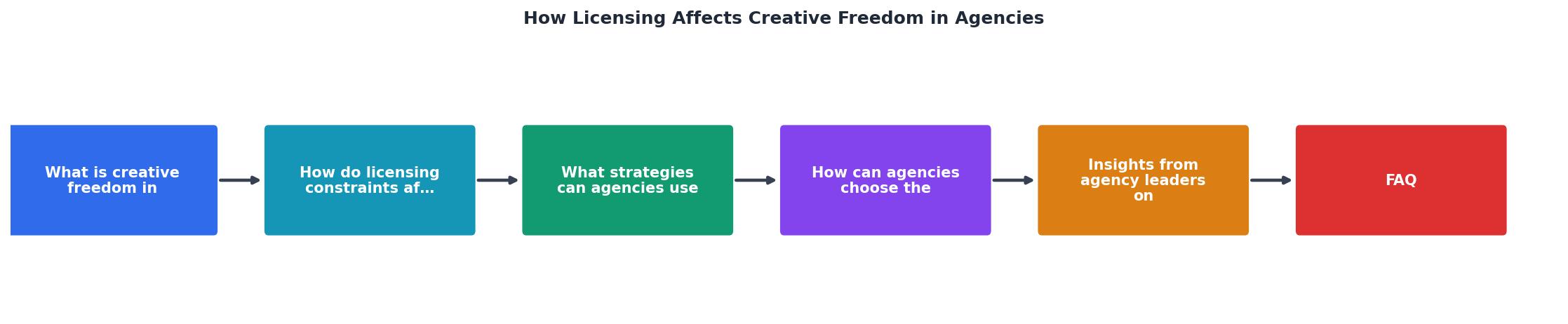
The diagram above shows the flow: Brief → Licence filter → Asset selection → Compliance check → Production → Archive proof. Each step is a gate that prevents problems from compounding downstream.
Fostering creativity within the rules
Here is what actually works for keeping creative energy high while staying compliant:
- Give designers access to multiple platforms. Restricting the team to a single stock library limits visual range. Subscriptions to Shutterstock, Adobe Stock, and Freepik together cost less than one copyright claim.
- Commission custom assets for hero visuals. For flagship campaigns, original photography or illustration eliminates licence constraints entirely. The agency owns the work outright.
- Use licence-friendly AI tools carefully. Adobe Firefly generates assets covered under Adobe's indemnification. This gives creative teams a new tool for concepting and even production, with clearer legal footing than many stock alternatives.
- Run quarterly licence audits. A quick review of active subscriptions, expiring licences, and asset usage across live campaigns catches problems before they become emergencies.
- Celebrate creative solutions within constraints. Some of the best campaign work comes from working around a limitation. Treat licence boundaries the same way you treat a tight budget or a short timeline: as a creative challenge, not a punishment.
Example: Mid-Size Agency Licence Breakdown
Licence Education Guide for Creative Teams
Your progress is saved automatically in your browser.
FAQ
Frequently Asked Questions
Additional Resources
- Intellectual property and creative freedom within the ... - This paper argues that moral as well as legal questions must be raised regarding the extent to which corporations should be effectively allowed to own elements ...
- Sharing Openly, Sharing Globally - Established in 2002, the CC licenses make it possible for everyone around the world to share knowledge, creativity, and culture, legally and freely. Licenses ...
- Artificial Intelligence and the Creative Double Bind - This Chapter explores AI's variable impact on how different artistic communities conceive of creativity and interact with the existing copyright regime.