
You planned a product launch for Friday. The social ads are designed, the landing page is live, and the email sequence is loaded. Then someone on your team realizes you cannot prove you actually licensed the hero image on the homepage. The launch stalls. This scenario plays out in small businesses more often than anyone admits, and the cost goes far beyond a missed deadline.
Photo by Leeloo The First from Pexels
TL;DR:- Licensing delays stall marketing campaigns, product launches, and seasonal promotions because teams cannot locate or verify proof of licence for stock images and media.
- Common causes include scattered records across platforms, confusion about licence types, and manual download processes that nobody maintains.
- Organizing your licence certificates in one place and using tools like Licence Downloader to bulk-retrieve proof cuts the delay from days to minutes.
The real cost of a missing licence
A delayed Facebook ad campaign does not just lose a day. It loses the audience window you planned around. A seasonal promotion that slips by 72 hours because you are hunting for a Canva Pro licence certificate can mean thousands in lost revenue for a small e-commerce store.
Stock image licensing is one of those admin tasks that feels trivial until it blocks something urgent. You bought the image. You paid for the subscription. But when a marketplace like Amazon or Etsy asks for proof, or when your ad gets flagged on Meta, the clock starts ticking and you need that certificate now.
The gap between "I know I licensed this" and "here is the PDF that proves it" is where projects die.
Common causes of licensing delays
Small businesses hit licensing bottlenecks for predictable reasons. Here are the ones that show up repeatedly:
- Records scattered across platforms. You use Canva for social posts, Freepik for blog headers, and Depositphotos for product shots. Each platform stores licence proof differently, in different account sections, with different export formats. Some bury it three clicks deep.
- Confusion about licence types. Free vs. paid, standard vs. extended, editorial vs. commercial. When you are not sure what you purchased, you hesitate to use the asset, and that hesitation delays the project.
- No single person owns the process. In a five-person business, the person who downloaded the image last March might not even work there anymore. Nobody documented which account was used.
- Manual retrieval is slow. Logging into each platform, finding the specific download, locating the licence certificate, and saving it to the right folder takes 10-15 minutes per image. Multiply that by 30 images for a product catalogue refresh.
- Reactive instead of proactive. Most small businesses only look for licence proof after a problem surfaces: a copyright claim, a platform flag, or a client request.
How delays hit your timeline

Licensing delays create a cascade effect. Here is how a single missing certificate can ripple through a small business:
- Marketing launch pushed back. Your designer finished the campaign assets. Your copywriter approved the text. But legal review (even informal) flags an image without clear licence proof. The campaign waits.
- E-commerce listing pulled. Amazon or Etsy receives a complaint about an image on your listing. You need to respond with proof within days. If you cannot find it, the listing stays down and you lose sales every hour.
- Ad account restricted. Meta's automated systems flag an image. You submit an appeal. Without a licence certificate attached, the appeal sits in limbo.
- Seasonal window missed. Holiday promotions, back-to-school campaigns, and Black Friday pushes have hard deadlines. A three-day delay in July is annoying. A three-day delay on November 22nd is catastrophic.
The pattern is consistent: the delay itself is short (usually 1-5 business days), but the impact is disproportionate because it hits at the worst possible moment.
Streamlining your licensing process

The fix is not complicated. It requires a system, not a miracle. Here is a streamlined process that works for businesses with 1-20 people:
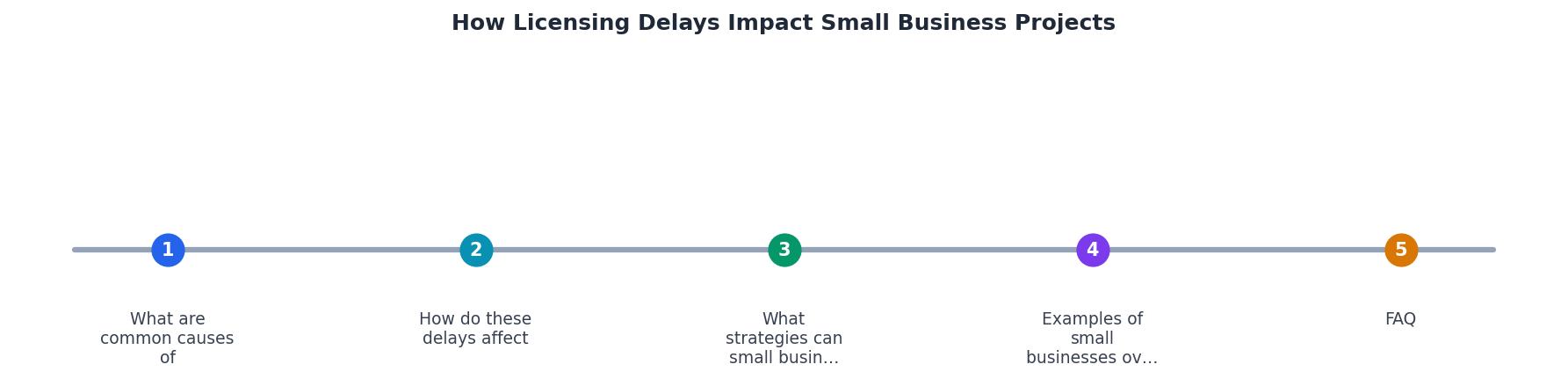
The diagram breaks it down into clear steps: Download Asset → Retrieve Licence → Store Proof → Link to Project → Verify Before Publish. Each step takes seconds when automated, minutes when manual, and hours when done reactively after a problem.
"The platform simplifies the experience by enabling direct online submissions and real-time tracking of status.">, Cutting Red Tape: A Case Study on Licensing and Permitting Reform
Practical strategies that work:
- Centralize your licence storage. Use a single Google Drive folder, Dropbox directory, or Notion database. Every licence certificate goes there, named with the asset filename and platform.
- Bulk-retrieve existing licences. If you have months or years of stock images without saved certificates, tools like Licence Downloader let you pull them from Freepik, Shutterstock, Adobe Stock, Canva, and other platforms in bulk instead of one at a time.
- Add licence checks to your publishing workflow. Before any asset goes live on your store, ads, or social channels, confirm the licence certificate exists in your archive. Make it a checkbox on your launch checklist.
- Document which accounts own which assets. A simple spreadsheet mapping "image filename → platform → account email → licence type" saves hours during a dispute.
| Manual Process | Streamlined Process |
|---|---|
| 10-15 min per licence retrieval | Under 1 min with bulk tools |
| Scattered across 4-5 platforms | Centralized in one folder |
| Reactive (after a problem) | Proactive (at download time) |
| No audit trail | Complete, searchable archive |
| Depends on one person's memory | Documented and team-accessible |
Small businesses that got it right
A few real-world patterns show what works:
The Etsy seller who pre-archived everything. One small jewellery business owner started saving Canva Pro licence certificates the same day she downloaded each image. When a competitor filed a false copyright claim on three of her listings, she responded within two hours with full documentation. Etsy restored the listings the next day. Without those certificates, the process would have taken a week or more.
The local restaurant chain that centralized. A three-location restaurant group used Freepik and Depositphotos for menu designs, social posts, and in-store signage. After a copyright troll sent a demand letter about a menu image, they spent two full days tracking down proof across three different employee accounts. They now maintain a shared folder and retrieve all certificates quarterly using bulk download tools.
The e-commerce brand that built it into onboarding. A small DTC skincare brand added "licence management" to their freelancer onboarding document. Every contractor who downloads stock media must save the licence certificate to a shared drive before submitting final deliverables. Result: zero licensing fire drills in 18 months.
Here is an example dashboard showing how a typical small business might track their licensing status across platforms:
Licence Status Dashboard (Example)
Your licensing delay prevention checklist
Streamline Your Licensing Process
Your progress is saved automatically in your browser.
FAQ
Frequently Asked Questions
What licensing bottleneck has cost your business the most time? Share your experience in the comments so others can learn from it.
Additional Resources
- Results: High Costs, Delays, and Complex Regulations ... - Delays Local government agencies are often siloed and bureaucratic, making starting a business a slow process for entrepreneurs—a reality that engenders ...
- A Case Study on Licensing and Permitting Reform - Without proper documentation, entrepreneurs risk fines, penalties, legal action, delays in operations, ineligibility for government programs, ...
- Construction business license compliance: Challenges ... - Operating without the correct licenses can trigger stop-work orders, lengthening timelines, straining client relationships, and driving up ...