
A single misunderstood licence clause cost one mid-size agency over $120,000 in settlement fees and six months of client trust. That story is not unusual. Creative and marketing agencies routinely operate under licensing assumptions that feel correct but crumble the moment a rights holder or client legal team asks for documentation. Correcting those assumptions before they become liabilities is cheaper, faster, and far less painful than dealing with the fallout.
Photo by Matheus Bertelli from Pexels
TL;DR:- Agencies commonly assume one licence covers the entire team, that editing an image removes licensing obligations, or that "royalty-free" means "free to use however you want."
- These misconceptions create real legal exposure, from takedown notices to six-figure settlements.
- Building clear internal protocols, centralizing licence records, and training every team member on the basics eliminates most of the risk.
Common Licensing Misconceptions

Agencies tend to cluster around the same set of wrong beliefs. Here are the ones that cause the most damage:
- "One seat licence covers the whole team." A standard licence on most platforms is tied to a single user. When a designer downloads an image under their personal Shutterstock seat and hands the file to a colleague for a different project, that second use often violates the licence terms. Multi-seat or enterprise plans exist for a reason.
- "Royalty-free means unlimited use." Royalty-free means you pay once and do not owe per-use royalties. It does not mean there are no restrictions. Royalty-free licences still cap print runs, prohibit resale of the asset itself, and restrict use in certain product categories like merchandise or templates.
- "Editing the image changes the licensing." Cropping, color-grading, compositing, or running an image through AI upscaling does not create a new work that escapes the original licence. The derivative still carries the original terms. If the base image required an extended licence for merchandise, your edited version does too.
- "We bought it years ago, so we're covered forever." Some licences are perpetual. Others are subscription-based and expire when the subscription lapses. Envato Elements, for example, requires an active subscription for continued use of downloaded assets in new projects. Using an asset from a cancelled subscription in a new client deliverable is a violation.
- "Free images have no restrictions." Assets from Freepik's free tier, Unsplash, or Pexels still carry attribution requirements or specific use limitations. "Free" describes the price, not the legal scope.
"The Encyclopedia of Popular Misconceptions: The Ultimate Debunker's Guide to Widely Accepted Fallacies.">, List of common misconceptions
The pattern is consistent: agencies confuse price with permission, and individual access with team-wide rights.
How These Misconceptions Create Risk
Each misconception maps directly to a category of operational or legal exposure:
- Licence violation notices. Rights holders and their enforcement partners (like PicRights or Copytrack) use reverse image search to find unlicensed usage. A single flagged image on a client's website triggers a demand letter, typically ranging from $750 to $5,000 per image.
- Client relationship damage. When a client's legal team receives a copyright claim tied to assets your agency provided, trust evaporates. The agency looks negligent, and the client questions every other deliverable.
- Audit failure. Enterprise clients in regulated industries (finance, healthcare, government) require documentation of asset provenance. An agency that cannot produce licence certificates on demand fails the audit and risks losing the contract.
- Compounding exposure at scale. One unlicensed image is a problem. Three hundred unlicensed images across fifty client projects is a catastrophe. Agencies that operate under false assumptions do not make one mistake; they make the same mistake hundreds of times.
Consequences of Non-Compliance

The consequences are not hypothetical. They follow a predictable escalation:
Stage 1: The demand letter. A rights holder or enforcement agency sends a letter claiming unauthorized use. The letter includes a settlement amount, usually between $1,000 and $10,000 per image. Most agencies pay to make it go away.
Stage 2: Repeated violations. Without systemic change, the same mistakes recur. A second or third demand letter from different rights holders signals a pattern, not an accident.
Stage 3: Client-side fallout. A client discovers that assets used in their campaign were improperly licensed. The agency faces contract penalties, indemnification claims, or termination.
Stage 4: Litigation. In cases involving willful infringement or large-scale misuse, rights holders pursue statutory damages. Under U.S. copyright law, statutory damages can reach $150,000 per work for willful infringement.
Consider a real-world pattern: an agency uses a photographer's image across twelve client social campaigns under a single-seat standard licence. The photographer's enforcement partner identifies all twelve uses. The demand is not for one licence fee. It is for twelve separate violations. The total easily reaches five figures before legal counsel even gets involved.
Building Clear Licensing Protocols

Fixing the problem requires structure, not just awareness. Here is what works:
Centralize licence storage. Every licence certificate, invoice, and download receipt goes into one system. Not scattered across individual email inboxes, browser download folders, or Slack threads. A tool like Licence Downloader can bulk-pull licence certificates from platforms like Shutterstock, Adobe Stock, Freepik, Envato, iStock, and Canva into a single archive. That archive becomes your single source of truth.
Map assets to projects. Each client project should have a record of which stock assets were used and which licence covers each one. This mapping is what makes audits painless instead of panicked.
Define who can download. Restrict stock platform access to designated users. When everyone on the team downloads from the same account without coordination, tracking becomes impossible.
Set licence type defaults. For client work that will appear on merchandise, in templates, or in high-volume print, default to extended licences. Standard licences cover most digital and editorial use, but the edge cases are where violations happen.
Review on offboarding. When a freelancer or employee leaves, audit which assets they downloaded and ensure the licences remain valid and accessible.
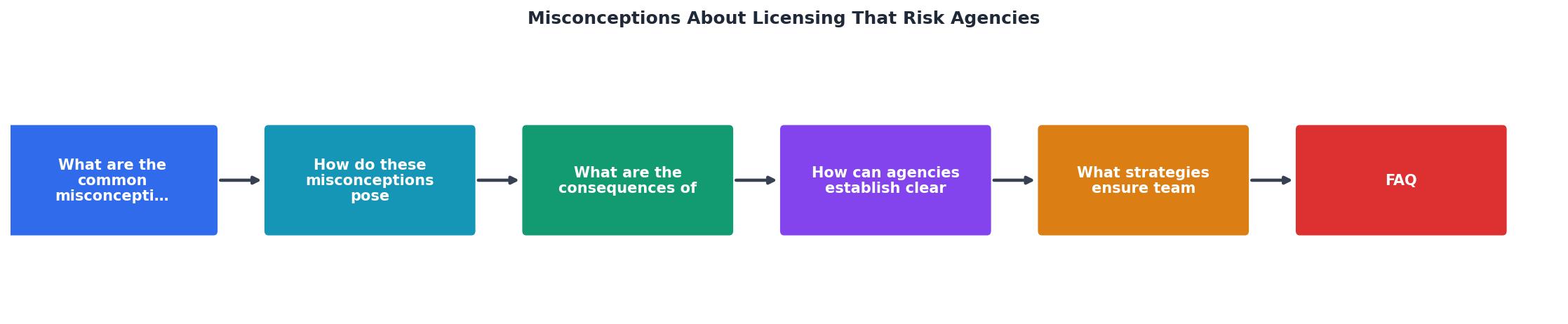
The diagram above outlines the compliance flow: Identify Assets, Verify Licence Type, Centralize Records, Map to Projects, Audit Regularly. Each step feeds the next. Skip one and the chain breaks.
Training Your Team on Licensing
Getting protocols on paper is half the job. The other half is making sure every person who touches a stock asset understands the rules.
Onboarding module. Every new hire and freelancer gets a 30-minute licensing orientation. Cover the five misconceptions listed above, show where licence records live, and walk through the download-and-log workflow.
Quarterly refreshers. Licensing terms change. Platforms update their agreements. A 15-minute quarterly update keeps the team current without eating into production time.
Accessible reference guide. A one-page cheat sheet pinned in Slack, Notion, or your project management tool. It answers: What licence type do I need? Where do I log the download? Who do I ask if I am unsure?
Spot checks. Randomly audit two or three projects per quarter. Check that every stock asset has a matching licence record. This is not about catching people. It is about catching gaps in the process before a rights holder does.
Here is an example dashboard showing what a well-managed agency's licensing compliance status might look like after implementing these protocols:
Agency Licensing Compliance Dashboard
Example data for a 25-person agency managing ~400 assets/month
| Without Licensing Protocols | With Licensing Protocols |
|---|---|
| Licences scattered across inboxes | Centralized licence archive |
| Audit requests take days or weeks | Audit responses in minutes |
| Freelancer offboarding loses records | Records persist independently |
| Repeated copyright claims | Proactive compliance, fewer claims |
| Team guesses at licence scope | Clear guidelines and defaults |
Agency Licensing Policy Template
Your progress is saved automatically in your browser.
FAQ
Frequently Asked Questions
What licensing assumption has caused the biggest headache at your agency? Share your experience so others can learn from it.
Additional Resources
- List of common misconceptions - Common misconceptions are widely accepted viewpoints or factoids that are actually false. They often arise from conventional wisdom (such as old wives' tales), ...
- MISCONCEPTION definition | Cambridge English Dictionary - an idea that is wrong because it has been based on a failure to understand a situation. We hope our work will help to change popular misconceptions about ...
- Misconceptions - Misconceptions are not isolated incidents, but rather normal outcomes of learning. Students may form misconceptions as a result of exposure to inaccurate ...