
Someone used your stock photo without permission. You want to get paid or at least make it stop. Two services keep showing up in every search result: Pixsy and Copytrack. Both promise to find stolen images and recover money on your behalf, but they work differently, charge differently, and suit different freelancers for different reasons. This guide breaks down exactly how each platform operates so you can pick the right one and protect your work without wasting billable hours.
Photo by Monstera Production from Pexels
TL;DR:- Pixsy offers free image monitoring and takes a 50% commission only on successful recoveries; best for freelancers who want a hands-off legal process.
- Copytrack also works on a no-win-no-fee basis (commission varies by case) and covers a wider international legal network; better for freelancers with global exposure.
- Neither replaces keeping your own licence records organized. Pair either service with proper licence documentation to avoid false positives and strengthen your claims.
Why Image Theft Hits Freelancers Hardest
A photographer or designer at a large agency has a legal department. You do not. When a client's competitor lifts your portfolio piece for a Facebook ad, you notice it at 11 PM while scrolling your phone. The next morning you have actual paid work to do. Chasing infringers falls to the bottom of the list, and the theft goes unresolved.
That scale is staggering. Freelancers create a disproportionate share of the visual content circulating online, yet they recover compensation on a tiny fraction of infringements. Services like Pixsy and Copytrack exist specifically to close that gap.

How Pixsy Works
Pixsy scans the web for copies of images you upload to its dashboard. Once it finds a match, you review the case and decide whether to submit it for resolution. Pixsy partners with law firms in multiple countries to pursue compensation on your behalf.
"Submitting a case for resolution is free - we only charge a fee if we can successfully resolve your case (50% of the recovery).">, Image Theft Protection
Key features for freelancers:
- Free monitoring on a limited number of images (the free plan covers up to 500 images).
- No upfront legal costs. You pay nothing unless Pixsy collects money.
- Case dashboard where you track each infringement from detection to resolution.
- DMCA takedown tools built into the platform for cases you want removed rather than compensated.
How Copytrack Works

Copytrack follows a similar model: upload images, let the crawler find unauthorized uses, then submit cases for enforcement. The differences are in the details.
- Commission structure: Copytrack's fee varies. For cases resolved without litigation, the commission can be lower than Pixsy's flat 50%. Litigated cases carry a higher percentage.
- Global legal network: Copytrack emphasizes its reach across European jurisdictions, which matters if your work gets used by companies in Germany, France, or the Nordics.
- No image limit on the free plan. You can register an unlimited number of images for monitoring without paying a subscription.
- Post-licensing option: Instead of pursuing damages, Copytrack can offer the infringer a retroactive licence. This sometimes resolves faster and preserves a potential client relationship.
Side-by-Side Comparison
Here is a quick comparison of the two platforms across the factors that matter most to freelancers working with stock imagery and client deliverables.
| Feature | Pixsy | Copytrack |
|---|---|---|
| Free monitoring | Up to 500 images | Unlimited images |
| Commission (no litigation) | 50% | ~30% (varies) |
| Commission (with litigation) | 50% | Higher % (varies) |
| DMCA takedown tools | Yes | Limited |
| Post-licensing option | No | Yes |
| Strongest legal coverage | US, UK, EU | EU (especially DACH region) |
| Upfront cost | $0 | $0 |
Choosing the Right Service
The decision depends on three things:
- Where your images get used. If most of your clients and infringers are in the US or UK, Pixsy's legal partners are well-established there. If you see unauthorized use across continental Europe, Copytrack's network gives you an edge.
- Volume of images. Freelancers with large portfolios (1,000+ images) benefit from Copytrack's unlimited free monitoring. If you have a smaller, curated set of high-value images, Pixsy's 500-image free tier is enough.
- Preferred resolution style. Want the infringer to pay damages and stop? Pixsy leans toward enforcement. Open to converting an infringer into a paying client? Copytrack's post-licensing approach can do that.
Step-by-Step: Protecting Your Work
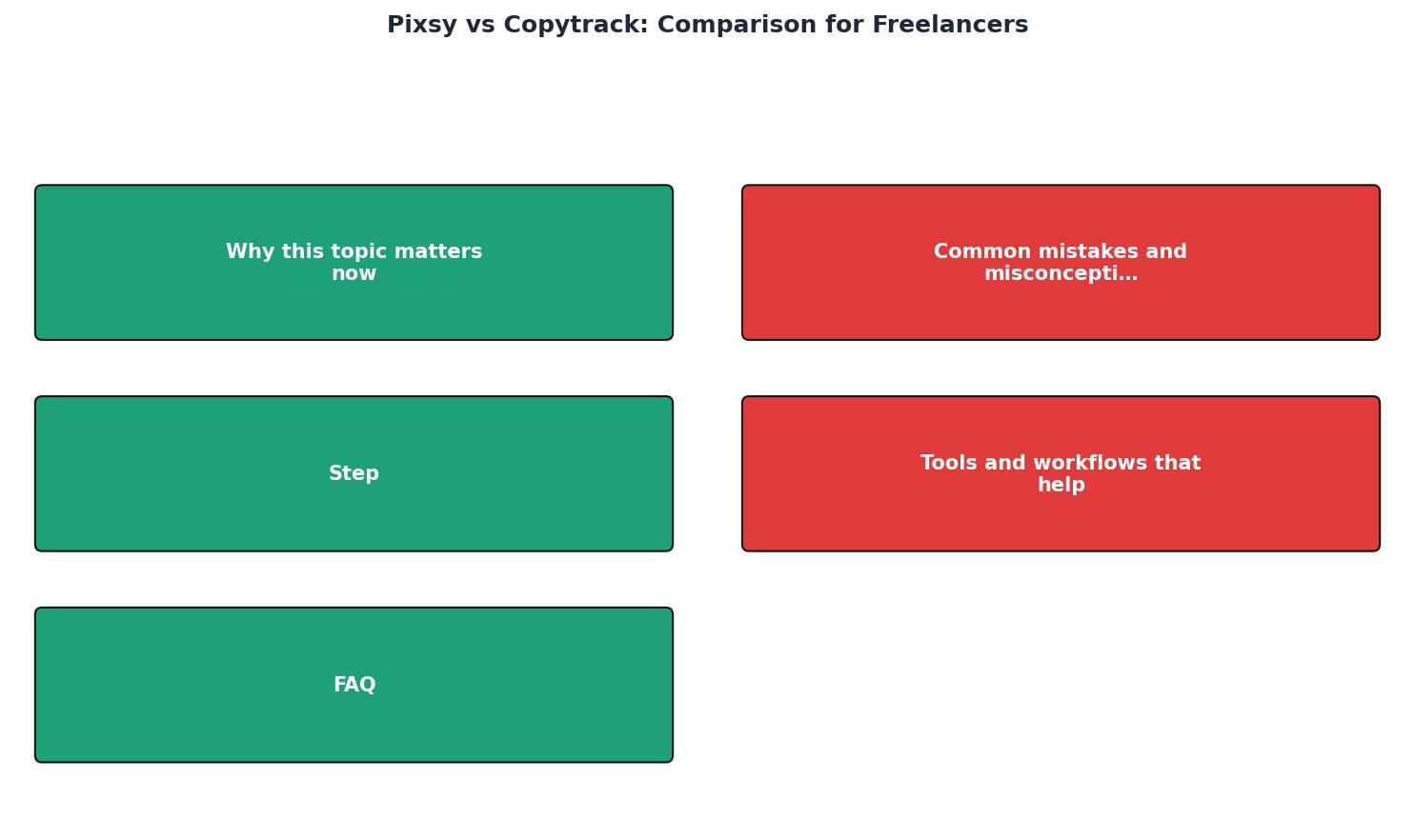
This process applies regardless of which service you choose. The steps below show the workflow from upload to resolution.
- Upload images to Pixsy, Copytrack, or both.
- Wait for matches. Both crawlers scan billions of pages. Results appear within days to weeks.
- Review matches. Not every match is infringement. Licensed uses, your own website, and social shares with proper credit are false positives.
- Submit valid cases. Select genuine infringements and submit them through the platform.
- Track resolution. Monitor your dashboard. Most cases resolve in 1-6 months.
- Collect payment. The service deposits your share after deducting commission.
The Licence Proof Problem
Here is where both Pixsy and Copytrack fall short for freelancers who use stock imagery in client work. These services protect images you created. They do not help when a stock platform or copyright troll sends you a claim for an image you legitimately licensed.
That is a completely different problem, and it requires a completely different solution: organized licence documentation.
When you download an image from Freepik, Shutterstock, or Adobe Stock, the licence certificate proves your right to use it. Months later, when a claim arrives, you need that certificate fast. Digging through email receipts and platform dashboards at that point is stressful and slow.
A tool like Licence Downloader lets you bulk-download licence certificates from multiple stock platforms into one organized archive. That way, if Pixsy or Copytrack flags one of your licensed stock images as a match on a client's site, you can quickly confirm it is a legitimate use and dismiss the false positive.
The comparison card below shows how Pixsy, Copytrack, and licence management tools each address a different part of the image protection puzzle for freelancers.
Pixsy
Finds unauthorized uses of YOUR images. Pursues damages via legal partners. 50% commission.
Copytrack
Finds unauthorized uses globally. Offers post-licensing or legal action. Variable commission.
Licence Records
Proves YOU have the right to use stock images. Bulk-download certificates. Stops false claims fast.
Freelancer Image Protection Checklist
Your progress is saved automatically in your browser.
FAQ
Frequently Asked Questions
What is your experience with image theft as a freelancer? Have you tried Pixsy, Copytrack, or another service? Share what worked and what did not in the comments below.
Additional Resources
- Infringements - My experience with both Pixsy and Copytrack has been disappointing. They suffer from some of the same problems as Pixsy in that they will find ...
- Pixsy: Image Theft Protection | Find and Fight Image Theft - Pixsy is an online service that allows photographers to track their images and see where and how they are being used. low-risk access to legal support and ...
- How to Response When You Receive the Email ... - Copytrack takes nearly half of the fees from those who take legal action, and after achieving success. It seems that Copytrack may be ...