
Photo by Marina Leonova from Pexels
When a global agency downloads a stock image in New York, uses it in a campaign for a London client, and repurposes it for a campaign running in Singapore, they're not just moving pixels across borders. They're navigating a maze of licensing rules that change with every jurisdiction. What's permitted under a US commercial licence might violate EU regulations, and what flies in Australia could expose the agency to liability in Japan. Regional licensing differences aren't academic concerns, they're operational roadblocks that cost agencies time, money, and legal credibility.
TL;DR:- Regional licensing rules differ significantly across jurisdictions, affecting how global agencies can use, distribute, and repurpose media assets.
- Compliance failures expose agencies to legal liability, client disputes, and platform takedowns that can damage reputation and revenue.
- Harmonizing practices through documentation, centralized tracking, and jurisdiction-aware workflows reduces risk and scales operations smoothly.
- Tools that track regional restrictions automatically prevent costly mistakes and keep audit trails ready.
What are regional licensing differences?

Regional licensing differences are variations in the legal rules governing how media can be used, distributed, and modified across different countries and regions. A stock image licence purchased in the US might grant broad commercial rights, but the same image under EU law might require additional consent for data processing, additional fees for certain uses, or restrictions tied to GDPR compliance.
These differences stem from several sources:
Copyright law variations. The US copyright system, UK law, and EU directives each define commercial use, derivative works, and attribution requirements differently. A US licence often assumes "work for hire" rules; EU law defaults to stronger creator protections.
Data protection rules. The GDPR in Europe, CCPA in California, and PIPEDA in Canada impose restrictions on how images containing people can be used. A portrait photo licensed for US advertising might need model consent paperwork in the EU before it can appear in a campaign targeting EU residents.
Moral rights and personality laws. France and Germany recognize strong moral rights, creators retain control over how their work is presented, even after sale. A licence that permits modification in the US might violate moral rights in France.
Industry-specific regulations. Financial services, healthcare, and education sectors have region-specific rules about imagery. A medical illustration licensed for US patient education materials might not be approved for EU distribution without additional regulatory clearance.
Platform rules. Meta, Amazon, and Google have their own terms that layer on top of jurisdiction-specific law. An image licensed for commercial use globally might still be rejected on Facebook if it violates their community standards or content policies in a specific region.
"The Entertainment/Characters sector remains the largest property type at $161.8 billion (a 41.5% share).">, Global Licensing Survey
How these differences impact global agencies

The operational and legal consequences of mishandling regional licensing are severe. Agencies don't just face fines, they face client disputes, campaign takedowns, and loss of reputation.
Client disputes and rework. A marketing agency in Toronto licensed stock video globally for a tech client's campaign. After launch in Germany, a rights holder challenged the use, claiming the licence didn't permit territorial extension without additional fees. The agency had to pull the campaign, rebid the work, and eat the cost. The client questioned the agency's competence.
Audit and compliance failures. When a regulatory body or client's legal team requests proof that all assets in a campaign are properly licensed for their jurisdiction, agencies without centralized tracking scramble. They dig through invoices, platform dashboards, and email archives. If they can't produce documentation within 48 hours, they risk the contract or face penalties.
Platform takedowns. An agency running ads in multiple countries on Meta or Google discovered too late that an image was flagged for copyright infringement in one region but not others. The entire campaign was suspended globally while the issue was investigated, leaving the client's product launch stalled.
Scaling challenges. As an agency grows globally, opening offices in Singapore, hiring freelancers in Poland, managing client accounts across time zones, the manual work of checking regional rules for every asset becomes impossible. Scaling without a system means either ignoring compliance (and accepting risk) or hiring a full-time compliance officer.
Examples of agencies managing regional complexities
Successful global agencies don't fight the system, they build workflows around it.
Tiered approval for regional launches. A London-based design agency established a rule: before any campaign launches in a new region, a checklist verifies:- Is the media licensed for that territory?
- Do GDPR rules require additional consent?
- Are there industry-specific restrictions?
- Does the platform's regional policy restrict the content type?
- Licence type (standard, extended, editorial only)
- Permitted territories (US-only, EU-permitted, global)
- Special restrictions (no GDPR personal data processing, model consent on file, etc.)
- Expiry date and renewal requirement
Vendor and platform diversity. Rather than relying on a single stock platform globally, savvy agencies subscribe to region-specific vendors. They use Shutterstock for US/UK, iStock for EU compliance-heavy work, and local platforms in Asia-Pacific. Each vendor's terms are tailored to regional law, reducing friction.
How can agencies harmonize licensing practices across borders?

Harmonization doesn't mean treating all regions the same, it means building consistent processes that respect regional differences and catch issues before they become crises.
Document and standardize licence terms. Create a master spreadsheet or simple database listing the key terms of every licence your agency holds:- Platform name (Freepik, Shutterstock, Adobe Stock, Canva, Envato Elements)
- Licence type (standard, extended, commercial, editorial)
- Permitted uses (web, print, video, derivatives, resale)
- Permitted territories
- Data processing rights (GDPR implications)
- Expiry and renewal dates
- US/North America checklist: Focus on copyright duration, work-for-hire rules, and FTC compliance for testimonials.
- EU/UK checklist: GDPR consent, moral rights, model releases, CCPA equivalents.
- Asia-Pacific checklist: Local platform policies, import/export rules, cultural sensitivities.
- Healthcare/Finance checklist: Regulatory approval, model consent, disclosure requirements.
Audit and refresh quarterly. Regional rules change. A new GDPR guidance, a platform policy shift, or a court ruling can affect compliance overnight. Quarterly audits of your asset library flag assets that no longer meet regional standards and trigger re-licensing or replacement.
Train team members on red flags. Most compliance failures aren't intentional, they're oversights by team members who don't know what to check. Train staff to recognize:- Images with identifiable people (require model consent in the EU)
- Assets licensed editorial-only (can't be used for commercial ads)
- Territorial restrictions that don't match the campaign geography
- Expired licences or platform accounts
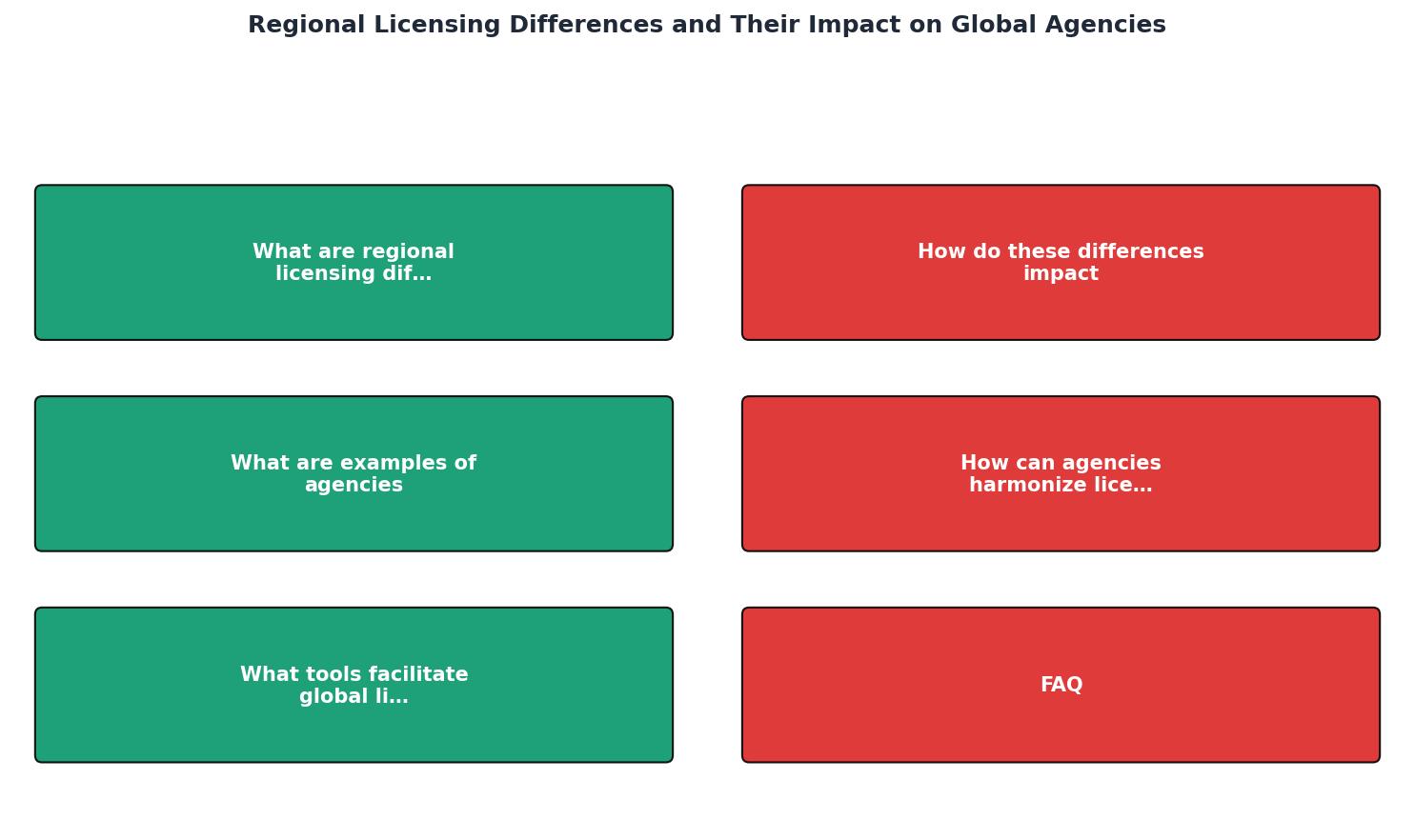
What tools facilitate global license management?
Modern tools can eliminate much of the manual work around regional licensing compliance. The best solutions combine centralized tracking, automated warnings, and audit-ready documentation.
Centralized asset management platforms. Tools like Frame.io, Dropbox (with metadata layers), or specialized DAM systems (Digital Asset Management) let agencies tag every asset with licence terms and territorial permissions. Team members can search by region, and compliance flags appear automatically when an asset is used outside its permitted territory.
Stock platform integrations and automation. Platforms like Freepik, Shutterstock, and Adobe Stock offer APIs and bulk export features that let agencies pull licence data programmatically. Connecting these to a central database means licence terms update automatically as subscriptions renew or assets expire.
Compliance checklist software. Tools like Typeform, Zapier, and custom-built integrations can automate approval workflows. A designer uploads an asset for a campaign in a new region, and the system automatically checks jurisdiction-specific compliance rules, flags issues, and routes approvals to the right person.
Invoice and contract management. Services like Airtable, Stripe, or specialized licensing platforms archive all subscription receipts and licence agreements. When a client requests proof of licensing for an audit, the team extracts the relevant documentation in minutes instead of hours.
Team communication and accountability. Slack bots, project management tools (Asana, Monday.com), and shared wikis ensure that compliance knowledge is accessible and up-to-date across distributed teams.
Practical guide: Harmonizing licensing practices across jurisdictions
This dashboard shows how a typical global agency might track compliance status across regions and sectors. When a region or sector shows "At Risk," it signals that licensing terms need audit or renegotiation before new campaigns launch.
Regional Licensing Harmonization Checklist
Your progress is saved automatically in your browser.
FAQ
Frequently Asked Questions
How does your agency currently handle licensing compliance when launching campaigns in new regions? Share your approach or challenges in the comments, many teams are building these systems for the first time and benefit from hearing what worked for others.
Additional Resources
- Global Analysis of General Trade and Operational Licensing - This paper examines the general purpose licensing imposed by central or local authorities, and the need to eliminate unnecessary licensing regulations ...
- Global Licensing Survey - Global sales revenue generated by licensed merchandise and services grew to $389.8 billion in 2025, a 5.45% increase over the $369.6 billion generated in 2024.
- Are Licensing Markets Local? An Analysis of the ... - They examine whether co-location affects the likelihood of vertical licensing transactions between biotechnology firms and global pharmaceutical firms.