Copytrack Response Dossier Template for Agencies
A Copytrack letter lands in your inbox on a Tuesday morning, and suddenly your entire team is scrambling through three different stock platforms trying to find a licence certificate from eight months ago. The image was licensed. You know it was licensed. But proving it under pressure, with a deadline ticking, is a different problem entirely.

A Copytrack letter lands in your inbox on a Tuesday morning, and suddenly your entire team is scrambling through three different stock platforms trying to find a licence certificate from eight months ago. The image was licensed. You know it was licensed. But proving it under pressure, with a deadline ticking, is a different problem entirely. This dossier template gives you a repeatable structure so the next Copytrack claim gets a calm, documented response instead of a panic spiral.
Photo by Pavel Danilyuk from Pexels
TL;DR:- Copytrack expects a structured response with licence proof, usage context, and clear identification of the disputed image.
- Your dossier should include the original licence certificate, download history, invoice/receipt, usage URL, and client handoff documentation.
- Agencies that keep a pre-built response template resolve claims faster and avoid unnecessary settlement payments.
What Copytrack Actually Expects
Copytrack operates as a copyright enforcement intermediary. Photographers upload images, Copytrack's crawler finds matches online, and the company sends demand letters on behalf of the rights holder. The letter typically includes a specific image URL, a claim amount, and a deadline.
Most Copytrack letters give you a short window to respond. Ignoring the letter does not make it go away. What Copytrack wants in a first response is straightforward:
- Acknowledgment that you received the claim
- Identification of the image in question (confirm or dispute the match)
- Licence proof showing you had the right to use the image at the time of publication
- Usage context explaining where and how the image appeared
"The victims of this shady enterprise are mostly small businesses and website operators, because they are apparently easier to intimidate and quicker to pay up.">, Copyright Infringement Notice Email from Copytrack
That quote captures why a structured response matters. Agencies that respond with organized proof signal they are not easy targets.
Documents to Gather From Stock Platforms

Every stock platform stores licence information differently, and that inconsistency is exactly what makes Copytrack responses painful. Here is what you need from each major platform:
Shutterstock:- Licence certificate (PDF download from your download history)
- Invoice/receipt showing the subscription or pack that covered the download
- Download history entry with timestamp and image ID
- Licence details page for the specific asset
- Purchase confirmation email or billing history entry
- The Adobe Stock licence agreement terms (standard vs. extended)
- Download record from your account history
- Premium subscription confirmation (if the image required Premium access)
- Attribution proof if the image was used under a free licence with attribution
- The licence certificate generated at download time (Envato creates one per download)
- Subscription status confirmation for the download date
- Project name associated with the download
Agencies that provide complete licence documentation resolve the vast majority of claims without payment. The key is having these documents before a claim arrives, not scrambling after.
Match Each Image to a Valid Licence

Copytrack's letter will reference a specific URL where the image appeared. Your job is to create a clear chain from that URL back to a valid licence. This is the core of the dossier.
The matching process follows these steps:
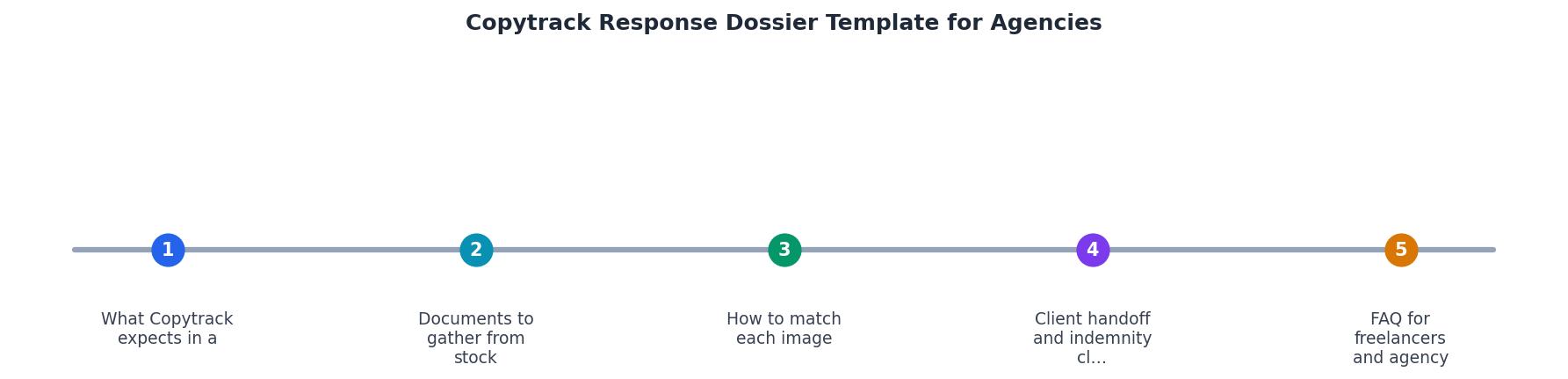
Walk through each step in order:
- Identify claimed image from the Copytrack letter (note the URL and image description)
- Search download history across all stock platform accounts for a visual or filename match
- Pull licence certificate for the matched download
- Verify licence scope to confirm the usage type (web, social, print) was covered
- Screenshot live usage showing the image as it appeared on the claimed URL
- Compile dossier with all documents in a single PDF or folder
Client Handoff and Indemnity Clauses

Here is where things get complicated for agencies. You licensed the image, built the website or campaign, and handed it to the client. Two years later, the client's site gets flagged by Copytrack. Who is responsible?
The answer depends entirely on your client handoff documentation and contract terms. Every agency dossier should include:
- Delivery receipt or sign-off showing when the project (including assets) was handed to the client
- Asset manifest listing every stock image used, with licence IDs
- Indemnity clause from your service agreement specifying who bears copyright liability post-delivery
- Licence transfer notes clarifying whether the client inherits the licence or needs their own
A well-drafted indemnity clause in your service agreement should state:
- The agency warrants that all assets delivered were properly licensed at the time of delivery
- The client assumes responsibility for maintaining proper usage after handoff
- Any modifications to asset usage post-delivery are the client's responsibility
The following interactive card shows what a typical agency dossier structure looks like when assembled for a single Copytrack claim:
Copytrack Response Dossier
Build Your Response Letter
With the dossier assembled, the actual response letter to Copytrack should be concise and factual. Avoid emotional language. Avoid threats. State the facts:
- Reference the Copytrack claim number
- Confirm the image in question
- State that the image was licensed through [platform name] under licence ID [number]
- Attach the licence certificate, download history, and invoice as supporting documents
- Request confirmation that the claim is resolved
| Without a Dossier Template | With a Dossier Template |
|---|---|
| Hours searching dashboards | Documents pre-organized |
| Missed deadlines | Response sent within 48 hrs |
| Inconsistent proof quality | Standardized evidence package |
| Panic-driven settlements | Informed decisions |
| No client liability clarity | Indemnity clause on file |
Copytrack Response Dossier Checklist
Your progress is saved automatically in your browser.
FAQ
Frequently Asked Questions
Additional Resources
- Copyright Infringement Notice Email from Copytrack - Here is an example of the first letter one of our clients received from COPYTRACK. For confidentiality, personalized details have been replaced with […].
- Copytrack Demand Letter? Here's What to Do (2026 Guide) - Your Copytrack Response Protocol · Preserve the Evidence · Validate the Claim Forensically · Demand Proof of Authorization · Build Your Defense Kit · Start Your $10 ...
- How to Response When You Receive the Email ... - Received a legal threat from Copytrack? Here's how I responded—and what you should know about copyright claims and your next steps.
Need to Download Your Licences?
Save hours of manual work. We download all your stock photo licence certificates for you.
Get Started“Thanks to LicenceDownloader.com, I was able to download more than 1,000 Freepik licences and receive them all at once via ZIP.”
Marlon Mainardy