Ensuring Project Coverage with Valid Licences
You finished a brand kit for a client six months ago. Now their lawyer emails asking for proof that every stock photo in the deck was properly licensed. You dig through three different platform dashboards, find two receipts, and realize the third image came from a Freepik subscription you already cancelled. That sinking feeling is entirely preventable with the right licence management habits.

You finished a brand kit for a client six months ago. Now their lawyer emails asking for proof that every stock photo in the deck was properly licensed. You dig through three different platform dashboards, find two receipts, and realize the third image came from a Freepik subscription you already cancelled. That sinking feeling is entirely preventable with the right licence management habits.
Photo by Rahul Pandit from Pexels
TL;DR:- Verify licence terms (scope, duration, usage limits) before delivering any project.
- Keep a centralized record of every stock asset: licence certificate, download date, platform, and the project it was used in.
- Audit your licence files at project close, not months later when a claim arrives.
- Avoid common pitfalls like using editorial-only images commercially or letting subscriptions lapse before downloading proof.
Why valid licence coverage matters
Stock image copyright claims cost freelancers anywhere from a few hundred to tens of thousands of dollars. The financial hit is bad enough. The reputational damage when a client discovers you used an unlicensed asset in their marketing materials is worse.
Most freelance designers juggle at least two stock platforms. Freepik for vectors, Adobe Stock for hero photography, maybe Envato Elements for templates. Each platform has its own licence terms, its own download history page, and its own way of issuing (or not issuing) certificates. Without a deliberate system, gaps appear fast.
The consequences break down into three categories:
- Legal liability - copyright holders or their enforcement agencies send demand letters with settlement amounts that assume commercial use.
- Client trust erosion - a single licence dispute makes a client question every asset you ever delivered.
- Platform account risk - repeated violations can lead to account suspension on the very platforms you depend on for work.
Freelancers who maintain organized licence records resolve disputes significantly faster and at lower cost than those who scramble to reconstruct their history after a claim lands.
How to verify licence coverage

Verification is not a single step. It is a short sequence you run for every asset before project delivery. Here is the process broken into concrete actions:
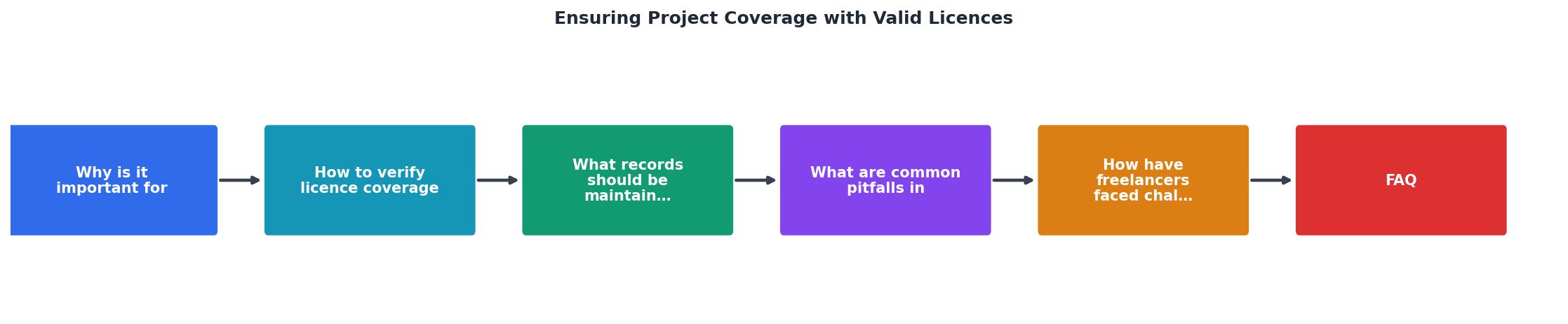
The diagram shows five steps: Identify Assets, Check Licence Type, Confirm Usage Scope, Download Certificate, and Archive with Project. Walk through each one:
- Identify Assets - List every stock file used in the project. Check your design files (Figma, Illustrator, InDesign) for linked or embedded images. Do not rely on memory.
- Check Licence Type - Open the platform where you downloaded the asset. Confirm whether you hold a standard, extended, or editorial licence. Freepik's standard licence, for example, does not cover print runs above 500,000 copies. Adobe Stock's standard licence prohibits use on merchandise.
- Confirm Usage Scope - Match the licence type against how the asset actually appears in the deliverable. A social media graphic is different from a billboard. An internal presentation is different from a product label.
- Download Certificate - Grab the licence certificate or proof-of-purchase PDF from the platform. Shutterstock provides downloadable licence certificates in your download history. Envato Elements generates a licence certificate per download. Freepik shows licence details on the asset page.
- Archive with Project - Store the certificate alongside the project files. Name it clearly:
project-name_asset-filename_licence.pdf.
Licensing requirements vary wildly across industries. Consider how different fields handle compliance:
"General Contractor with Residential Endorsement (required when residential work exceeds 25% of structure value), needs a 16-hour cold-climate course and pass a residential exam.">, 2026 Guide: General Contractor License Requirements in Every State
Stock media licensing is less regulated than construction licensing, but the principle holds: specific use cases demand specific proof. A freelancer using an image in a client's paid ad campaign needs different coverage than one using it in an internal mood board.
What records to maintain
A licence record is only useful if it contains enough detail to answer a challenge. Here is what each record should include:
- Asset filename and ID - the platform's unique identifier (e.g., Shutterstock image ID
2184739201). - Platform and account - which service and which account downloaded it.
- Download date - proves the asset was obtained during an active subscription or purchase.
- Licence type - standard, extended, editorial, or free with attribution.
- Licence certificate file - the actual PDF or screenshot from the platform.
- Project association - which client project used this asset and where it appeared.
- Usage context - web, print, social, merchandise, video, etc.
/licences/
  /client-name-project/
    hero-image_shutterstock-2184739201_licence.pdf
    icon-set_freepik-12345678_licence.pdf
For higher volumes, a tool like licencedownloader.com can bulk-download certificates from multiple platforms into a single archive, saving the manual dashboard-hopping that eats into billable hours.
The following example dashboard shows what a well-organized freelancer's licence tracking might look like after completing several client projects:
Example: Licence Coverage Dashboard
Common licence compliance pitfalls

Knowing what to do is half the job. Knowing what trips people up is the other half. These are the mistakes that show up repeatedly:
| Pitfall | What Goes Wrong | How to Prevent It |
|---|---|---|
| Using editorial images commercially | Editorial licences on Shutterstock and iStock prohibit commercial use; a product ad using an editorial photo triggers a claim | Always filter searches by "commercial" licence type before downloading |
| Letting subscriptions lapse | Some platforms restrict access to download history after cancellation; certificates become unretrievable | Download all certificates before cancelling any subscription |
| Assuming "free" means "unrestricted" | Freepik free-tier and Unsplash both require attribution; skipping it violates the licence | Read the specific licence terms for every free asset |
| Sharing login credentials | When multiple people download under one account, tracking who licensed what becomes impossible | Use separate seats or clearly log each download with the user's name |
| Ignoring territorial restrictions | Some licences limit use to specific regions; a global campaign may exceed the scope | Check geographic restrictions in the licence agreement |
In many jurisdictions, copyright holders have several years to file a claim. That brand kit you delivered in 2022 can still generate a demand letter in 2027. Your records need to last at least that long.
Real challenges freelancers have faced
Licence disputes are more common than most freelancers realize. Here are patterns that repeat across the industry:
The cancelled subscription trap. A designer used Envato Elements for a year, downloaded hundreds of assets, and built them into client projects. After switching to Adobe Stock, she cancelled Envato. Two years later, a client received a copyright inquiry about a template used in their website. The designer could not access her Envato download history because the account was deactivated. Reactivating it and retrieving the licence certificate took weeks and cost a month of subscription fees.
The editorial image mistake. A freelancer grabbed a photo from iStock for a client's Facebook ad campaign. The image was licensed under an editorial-only agreement. The rights holder's enforcement agency sent a demand letter for $1,500. The freelancer paid because fighting it would have cost more in legal fees.
The attribution gap. A designer used Freepik free-tier images in a logo presentation deck. The free licence required visible attribution. The client removed the attribution when publishing the deck on their website. The designer received the complaint because the download was tied to their account.
Each of these situations would have been prevented or quickly resolved with a proper licence record system.
Project coverage checklist
Use this checklist at the close of every client project to confirm full licence coverage:
Project Licence Coverage Checklist
Your progress is saved automatically in your browser.
FAQ
Frequently Asked Questions
Additional Resources
- General contractor license requirements by state - General liability insurance is required for all licensed contractors. Workers' compensation insurance is required if you have employees.
- General Contractor Insurance Requirements for Licensing ... - Generally, in most states, it is legally necessary to have general liability insurance to get a contractor license. 2. Do I need insurance to ...
- Verify Your Contractor: Ensure They Are Licensed and ... - Ensure your contractor is licensed and insured to protect your investment. Learn key steps to verify credentials and make informed hiring ...
Need to Download Your Licences?
Save hours of manual work. We download all your stock photo licence certificates for you.
Get Started“Thanks to LicenceDownloader.com, I was able to download more than 1,000 Freepik licences and receive them all at once via ZIP.”
Marlon Mainardy