Handling Licence Disputes with Stock Agencies
A stock agency sends your client a five-figure invoice claiming unlicensed use of an image your team downloaded two years ago. The designer who pulled the asset left the company six months back, and nobody can find the licence certificate. This scenario plays out at agencies every single week, and the resolution almost always comes down to one thing: documentation you either have or you do not.

A stock agency sends your client a five-figure invoice claiming unlicensed use of an image your team downloaded two years ago. The designer who pulled the asset left the company six months back, and nobody can find the licence certificate. This scenario plays out at agencies every single week, and the resolution almost always comes down to one thing: documentation you either have or you do not.
Photo by cottonbro studio from Pexels
TL;DR:- Most licence disputes stem from missing documentation, expired subscriptions, or scope-of-use misunderstandings.
- Build a centralized, timestamped archive of every licence certificate the moment an asset is downloaded.
- Communicate with stock agencies using structured written correspondence, and escalate to legal counsel only after internal documentation review and at least one formal written dispute.
Why licence disputes happen
Stock licence disputes rarely start with intentional misuse. They start with gaps. A team member downloads an image from Shutterstock under a subscription that later lapses. Someone uses an Adobe Stock asset in a way the Standard licence does not cover. A freelancer pulls an image from their personal Envato Elements account for an agency project, and when they leave, the licence trail vanishes.
Here are the most common dispute triggers for agencies:
- Expired subscriptions where assets remain in use after the plan ends.
- Scope violations such as using a Standard licence image on merchandise that requires an Extended licence.
- Seat/user mismatches where a freelancer's personal account was used for agency work.
- Platform migration confusion when an agency switches from one stock provider to another and old assets stay in production files.
- Automated copyright detection by services like Pixsy or PicRights flagging images on client websites.
"Alamy, for example, pays 40 percent (dropped from 50 percent in February 2019), while the likes of Adobe, Fotolia, and Shutterstock offer 33 percent.">, Selling Through Stock Photography Sites, Pros & Cons
That revenue split matters because it explains why agencies and their enforcement partners pursue claims aggressively. A single image can generate hundreds or thousands in settlement fees, making automated detection a profitable business model.
Document usage from day one

Documentation is the entire game. If you can produce a valid licence certificate with a timestamp, asset ID, and licence type within 48 hours of receiving a claim, most disputes end right there.
Here is what an agency-grade documentation system looks like:
- Asset ID and source platform recorded at the moment of download (e.g., Shutterstock image #1234567890).
- Licence certificate PDF saved to a shared, backed-up location, not someone's desktop.
- Project association linking each asset to the client project and deliverable where it was used.
- Download date and account holder so you know which subscription and which user pulled the file.
- Licence type (Standard, Enhanced, Extended, Editorial) recorded explicitly.
Agencies that maintain this kind of archive resolve the vast majority of disputes without legal fees. The ones that do not end up paying settlements simply because they cannot prove what they already paid for.
A tool like Licence Downloader can bulk-pull licence certificates from platforms like Shutterstock, Adobe Stock, Envato Elements, iStock, and Freepik into a single archive. That turns a multi-hour scavenger hunt across six different dashboards into a few minutes of automated retrieval.
Communicate with stock agencies

When a dispute lands in your inbox, the first instinct is often to panic or ignore it. Both are wrong. Stock agencies and their enforcement partners follow a predictable process, and your response needs to match it with structure and precision.
Step 1: Verify the claim
Check the image ID or URL referenced in the claim against your internal records. Confirm whether the asset was actually used, where, and under what licence. Sometimes the claim targets an image you never used, or one that was removed months ago.
Step 2: Gather your evidence
Pull the licence certificate, the download receipt, the subscription confirmation for the period in question, and a screenshot showing the asset in context. Bundle these into a single PDF or folder.
Step 3: Respond in writing
Always respond via email or the platform's official dispute channel. Never call. Written records protect you. Keep the tone professional and factual:
- State the asset ID and your licence reference number.
- Attach the licence certificate and proof of active subscription at the time of use.
- Specify the scope of use and confirm it falls within the licence terms.
Step 4: Request written confirmation
Ask the agency or enforcement company to confirm in writing that the dispute is resolved. Do not assume silence means resolution.
The following diagram shows this process at a glance:
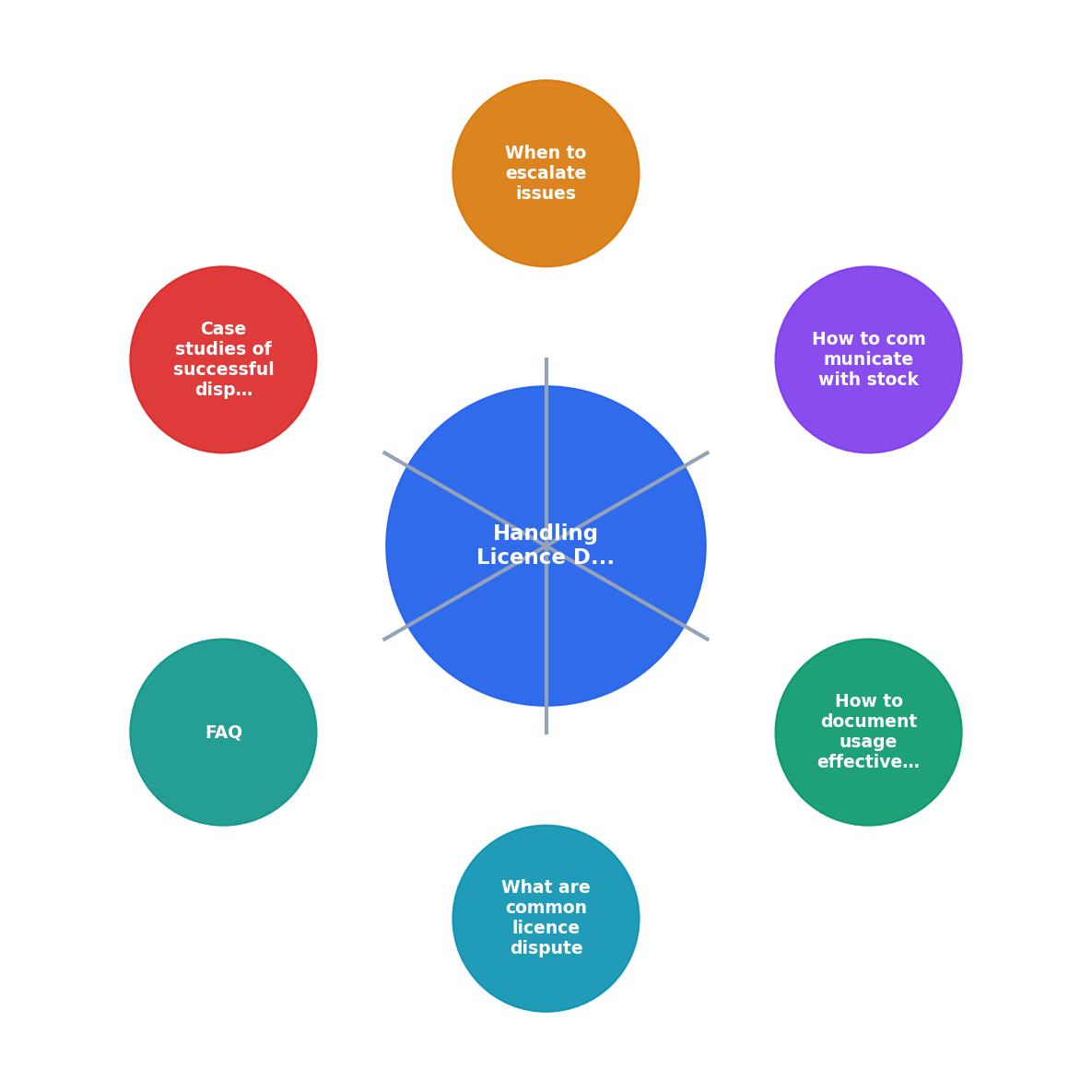
When referencing these steps internally, use the short labels: Verify, Gather, Respond, Confirm. They map directly to the four stages in the diagram and make internal handoff between your ops team and legal counsel clean.
| Reactive Approach | Proactive Approach |
|---|---|
| Scramble for proof after a claim arrives | Archive certificates at download time |
| Individual team members hold records locally | Centralized shared licence repository |
| Respond verbally or delay response | Structured written response within 48 hours |
| Pay settlements to avoid hassle | Resolve with documentation, escalate only when needed |
| No post-incident review | Update process after every dispute |
When to escalate a dispute

Not every dispute resolves with a polite email and a PDF attachment. Some require escalation. Knowing when to escalate saves both money and time.
Escalate when:
- The agency rejects your documentation without a clear explanation.
- The claimed damages exceed your internal threshold (many agencies set this at $1,000 or $2,500).
- The claim involves an asset you genuinely cannot locate a licence for.
- The enforcement company threatens legal action with a specific deadline.
- Multiple claims arrive simultaneously, suggesting a systematic gap in your records.
- Internal legal review first. Your agency's counsel or a retained IP attorney should review the claim and your documentation before any external response beyond the initial structured reply.
- Formal written dispute via the stock platform's official process. Shutterstock, Adobe Stock, and Getty/iStock all have documented dispute procedures.
- Negotiated settlement if the licence gap is real. Paying for the correct licence retroactively is almost always cheaper than litigation.
- External legal counsel specializing in intellectual property if the claim reaches formal legal proceedings.
The overwhelming majority of stock licence disputes never reach a courtroom. They settle through documentation, negotiation, or retroactive licensing. Litigation is expensive for both sides, and enforcement companies know this.
Case studies of successful resolutions
Real-world examples illustrate how documentation and process make the difference.
Case 1: The expired Shutterstock subscription. A mid-size marketing agency received a claim for 12 images used on client websites. The subscription had lapsed eight months earlier. The agency's ops lead pulled the original licence certificates (downloaded via Licence Downloader before the subscription ended), confirmed each image was downloaded during the active subscription period, and submitted the documentation. Shutterstock's terms allow continued use of assets downloaded during an active subscription. The claim was dropped within two weeks.
Case 2: The freelancer's personal Envato account. A freelancer used their personal Envato Elements subscription to download templates for agency client work. After the freelancer left, Envato's terms technically did not cover the agency's continued use. The agency negotiated a retroactive Team subscription and re-downloaded the assets under the correct account. Total cost: the price of a Team plan. Without escalation to legal, the agency resolved the issue in under a month.
Case 3: The PicRights automated detection. A client's legal team forwarded a PicRights demand letter for an image on the client's blog. The agency traced the image to an iStock download, produced the licence certificate with matching asset ID, and responded directly to PicRights with the documentation. PicRights confirmed resolution in five business days.
Here is an example dashboard showing how a typical agency might track dispute status across multiple claims:
Agency Dispute Tracker (Example Q2 2026)
Prevent disputes before they start
Prevention costs a fraction of what resolution does. Here are the structural changes that eliminate most disputes before they begin:
- Centralize all stock downloads through shared team accounts, never personal ones.
- Archive licence certificates immediately after every download session.
- Audit active subscriptions quarterly to catch lapses before they create gaps.
- Tag every asset with the client project, licence type, and expiration date (if applicable).
- Onboard and offboard freelancers with a clear stock-asset handoff checklist.
- Use a tool built for this. Licence Downloader automates the bulk retrieval of licence certificates across platforms, which removes the human error that causes most documentation gaps.
Only about 60% of agencies have any formal process for managing stock licences. The other 40% rely on individual team members to "just handle it." That works until it does not.
Licence Dispute Readiness Checklist
Your progress is saved automatically in your browser.
FAQ
Frequently Asked Questions
Additional Resources
- Stock agencies – what do you give up when you sign up? - As we've already seen, stock agencies typically prioritize their client, which means that when it comes to resolving disputes, photographers are ...
- Can a Licensing Agent Also Enforce the Copyright in ... - It is very difficult, perhaps impossible, to devise an arrangement under which a non-exclusive licensing agent can also prosecute infringements on behalf of ...
- Licensing stock in clients name - Most stock agencies don't allow you to transfer the license of the photo you've purchased, even though you can use it for client work.
Need to Download Your Licences?
Save hours of manual work. We download all your stock photo licence certificates for you.
Get Started“Thanks to LicenceDownloader.com, I was able to download more than 1,000 Freepik licences and receive them all at once via ZIP.”
Marlon Mainardy