Keeping Freepik Licences Organized for Future Reference
Three months after delivering a brand kit, a client emails asking for proof that the hero image on their homepage is properly licensed. You know you downloaded it from Freepik. You know you had a valid subscription. But the actual licence certificate?


Three months after delivering a brand kit, a client emails asking for proof that the hero image on their homepage is properly licensed. You know you downloaded it from Freepik. You know you had a valid subscription. But the actual licence certificate? Buried somewhere between your Downloads folder, an old hard drive, and a vague memory of a PDF you once opened. This guide walks you through building a filing system that makes every Freepik licence retrievable in under 30 seconds.
Photo by Jakub Zerdzicki from Pexels
TL;DR:- Create a dedicated folder structure in a cloud service with subfolders per client and project.
- Use a consistent naming convention that includes the platform, asset ID, date, and licence type.
- Tag files with metadata so your operating system or cloud search can find any licence instantly.
- Automate the download step with Licence Downloader to skip the manual export grind.
Why organized licences matter
Every Freepik asset you use commercially comes with a licence agreement. That agreement is your legal shield. Without it, a copyright dispute turns into a "your word against theirs" situation, and that never ends well for the designer.
Beyond legal protection, organized licences save real time. Freelancers who bill by the hour lose money every time they dig through Freepik's download history trying to locate a specific certificate. Multiply that by dozens of projects per year, and the wasted hours add up fast.
Clients expect professionalism. Handing over a neatly organized licence folder alongside your final deliverables signals that you take intellectual property seriously. It builds trust and reduces back-and-forth emails months down the line.
Build a digital filing system

The foundation is a cloud storage service you already use. Google Drive, Dropbox, OneDrive, or iCloud all work. The specific platform matters less than the consistency of your structure inside it.
Start with a top-level folder called Licences (or Stock-Licences if you want to separate it from software licences). Inside that, create one subfolder per stock platform you use:
Licences/Freepik/Licences/Adobe-Stock/Licences/Envato/Licences/Shutterstock/
Licences/Freepik/2025/Licences/Freepik/2026/
Licences/Freepik/2026/ClientName-ProjectName/
Naming conventions that work
A file called licence.pdf tells you nothing. A file called freepik-12345678-2026-01-15-premium.pdf tells you everything.
Here is the naming pattern that works best for Freepik licences:
[platform]-[assetID]-[YYYY-MM-DD]-[licencetype].[ext]
Breaking that down:
- Platform prefix -
freepik,adobestock,envato, etc. - Asset ID - the unique number Freepik assigns to each resource (visible in the URL or download details).
- Date - the download or purchase date in ISO format (
YYYY-MM-DD) so files sort chronologically. - Licence type -
premium,free-attribution, oreditorialdepending on what you purchased.
freepik-28491037-2026-03-12-premium.pdffreepik-31205844-2026-06-01-free-attribution.pdf
| Bad Naming | Good Naming |
|---|---|
licence.pdf | freepik-28491037-2026-03-12-premium.pdf |
download (3).pdf | freepik-31205844-2026-06-01-free-attribution.pdf |
Freepik cert.pdf | freepik-44019283-2025-11-20-premium.pdf |
| Date + ID + type in every filename |
This convention works across every stock platform. Swap the prefix, keep the pattern, and your entire licence archive becomes searchable with a single keyword.
Use metadata for searchability

Good filenames get you 80% of the way. Metadata closes the remaining gap.
Most cloud services let you add tags, descriptions, or comments to files. Use them. For each licence file, add:
- The client name the asset was used for.
- The project name or deliverable type (e.g., "Instagram campaign Q2").
- The asset description (e.g., "flat vector illustration of a coffee shop interior").
- Any usage restrictions worth noting (e.g., "no print-on-demand use").
When a client asks "do we have a licence for that coffee shop illustration?", you type "coffee shop" into your cloud search bar and the tagged file appears instantly. No folder diving required.
"The attribution must always be clear, visible, and easy to find for your audience.">, Licenses & attribution
Set up cloud folders step by step
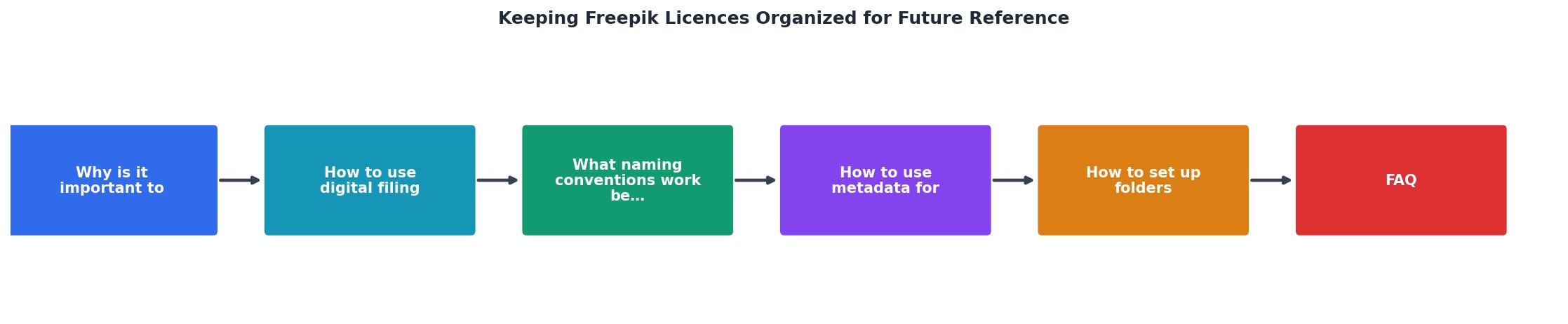
Here is the exact process, from zero to a working system:
- Pick cloud service - choose one you already pay for and use daily.
- Create root folder - name it
Stock-Licencesat the top level of your drive. - Add platform subfolders - one per stock service (
Freepik,Adobe-Stock, etc.). - Add year subfolders - inside each platform folder, create the current year.
- Download licences - export certificates from Freepik's download history or use Licence Downloader to pull them in bulk.
- Rename files - apply the naming convention:
platform-assetID-date-type.ext. - Tag with metadata - add client name, project, and asset description.
- Share folder - give clients read-only access to their project subfolder when needed.
Here is an example of what a mature folder structure looks like for a freelancer managing three clients:
📁 Freepik/
📁 2025/
📁 Bloom-Bakery-Rebrand/
📄 freepik-28491037-2025-09-14-premium.pdf
📄 freepik-28503211-2025-09-14-premium.pdf
📁 2026/
📁 Nova-Fitness-Social/
📄 freepik-31205844-2026-01-22-premium.pdf
📁 Patel-Law-Website/
📄 freepik-44019283-2026-06-01-premium.pdf
📄 freepik-44019290-2026-06-01-free-attribution.pdf
📁 Adobe-Stock/
📁 2026/
📄 adobestock-582910374-2026-02-10-standard.pdf
Share licences with clients

Some clients want licence proof included in the final handoff. Others ask for it six months later when their legal team runs an audit. Either way, your system should handle both scenarios without extra work.
The simplest approach: share the client's project subfolder directly. Google Drive and Dropbox both support read-only sharing links. The client sees only their licences, not your entire archive.
For clients who prefer email, export the relevant PDFs and attach them. With consistent naming, you find the right files in seconds.
If you work with agencies or larger teams, consider creating a shared team drive where project managers can self-serve. This eliminates you as a bottleneck and keeps the licence trail intact even if you stop working with that client.
Steps to Set Up Your Freepik Licence Filing System
Your progress is saved automatically in your browser.
FAQ
Frequently Asked Questions
freepik-assetID-date-type) makes files findable through basic filename search. Adding tags with client names, project titles, and asset descriptions in your cloud service covers searches where you remember the context but not the asset ID. Together, these two layers mean you can search by any detail you remember and still find the right file.adobestock, envato, shutterstock, canva) and keep everything else identical. This gives you a single unified archive across all your stock subscriptions. Tools like Licence Downloader support multiple platforms, so you can pull certificates from Freepik, Shutterstock, Adobe Stock, and others into the same system.Additional Resources
- Licenses & attribution | Magnific Docs - Understand Magnific license types, when attribution is required, how to attribute correctly, and how to download and manage your license documents.
- Freepik Terms of use - No Implied Licenses. 13.1 Ownership. Freepik and its licensors shall keep and maintain all rights (including intellectual and industrial property rights, such ...
- [Can I modify a freepik and then sell it? [closed]](https://graphicdesign.stackexchange.com/questions/106858/can-i-modify-a-freepik-and-then-sell-it) - Closed. This question needs to be more focused. It is not currently accepting answers. Want to improve this question? Guide the asker to update ...
Need to Download Your Licences?
Save hours of manual work. We download all your stock photo licence certificates for you.
Get Started“Thanks to LicenceDownloader.com, I was able to download more than 1,000 Freepik licences and receive them all at once via ZIP.”
Marlon Mainardy