Legal Implications of Misusing Shutterstock Licences
You downloaded a Shutterstock image for a client project two years ago. Today, a letter arrives demanding thousands of dollars because the licence did not cover the way you actually used it. This scenario is not hypothetical. Freelance designers face licence disputes regularly, and the consequences go far beyond a simple invoice.


You downloaded a Shutterstock image for a client project two years ago. Today, a letter arrives demanding thousands of dollars because the licence did not cover the way you actually used it. This scenario is not hypothetical. Freelance designers face licence disputes regularly, and the consequences go far beyond a simple invoice. Understanding exactly what Shutterstock considers misuse, and knowing how to stay compliant, is the difference between a minor admin task and a career-damaging legal problem.
Photo by KATRIN BOLOVTSOVA from Pexels
TL;DR:- Misusing a Shutterstock licence includes exceeding print run limits, using images after a subscription lapses, sublicensing to clients, or using editorial images commercially.
- Legal consequences range from statutory damages of up to $150,000 per infringement to DMCA takedowns and permanent reputation damage.
- Staying compliant requires understanding your specific licence type, keeping proof of every download, and auditing your usage regularly.
What counts as licence misuse?
Shutterstock sells images under specific licence agreements. The two main types are the Standard Licence and the Enhanced Licence. Each comes with explicit restrictions on print runs, distribution formats, and commercial scope. Misuse happens when you step outside those boundaries, whether you meant to or not.
Here are the most common forms of misuse freelance designers stumble into:
- Exceeding print run limits - The Standard Licence caps physical reproductions at 500,000 copies. A client's brochure that goes viral at a trade show can blow past that number fast.
- Using images after subscription cancellation - Shutterstock's subscription plans grant licences for images downloaded during the active period. But some designers assume they can keep using the account's download history indefinitely, even after cancellation. The licence for each image persists, but only for uses that began during the subscription.
- Sublicensing to clients - Handing a client the raw Shutterstock file and telling them "it's licensed" does not transfer the licence. The licence is tied to your account, not to the file itself.
- Editorial images in commercial contexts - Shutterstock marks certain images as "editorial use only." Using a photo of a celebrity at an event in a product advertisement is a textbook violation.
- Using images in templates for resale - Creating a Canva template or a website theme that includes a Shutterstock image and selling it to multiple buyers violates the Standard Licence.
What are the legal risks?
The financial exposure from licence misuse is not trivial. Shutterstock actively monitors image usage through reverse image search technology and third-party enforcement partners. When they find unauthorized use, the response follows a predictable escalation path.
Cease-and-desist letters arrive first. These demand you remove the image and often include a settlement offer. Settlement amounts typically range from $1,000 to $25,000 per image, depending on the scope of misuse and the commercial value of the project.
If you ignore the letter or dispute it without evidence, the next step is a formal copyright infringement claim. Under US copyright law (Title 17, Section 504), statutory damages can reach $150,000 per work for willful infringement. Even for non-willful infringement, the minimum is $750 per image.
Beyond direct financial penalties, there are secondary consequences:
- DMCA takedowns on websites, social media posts, and ad platforms. A takedown on a client's live campaign creates immediate business damage.
- Platform account suspension on Shutterstock itself, cutting off access to your download history and licence records.
- Legal fees that accumulate regardless of the outcome. Defending a copyright claim costs $5,000 to $50,000+ in attorney fees alone.
Most cases settle before reaching court, but the settlement process itself is expensive and stressful. The leverage sits entirely with the copyright holder when you cannot produce licence documentation.
How misuse damages your reputation
A copyright claim does not stay between you and Shutterstock. It ripples outward.
Clients who receive DMCA notices for assets you provided will question your professionalism. Some will terminate contracts immediately. Others will demand indemnification, meaning you pay for their legal costs too. Word travels fast in freelance communities and client referral networks.
Consider this scenario: you deliver a brand kit to a small business client. Six months later, Shutterstock's enforcement partner flags one of the images on the client's website. The client gets a threatening letter. They call you. You cannot find the licence certificate because you never downloaded it, or your subscription lapsed and you lost access to the download history.
That single incident can cost you:
- The client relationship (and all future referrals from them)
- Your reputation in their business network
- Hours of unpaid time resolving the dispute
- Potential financial liability if the client sues you for breach of contract
The reputational cost often exceeds the financial penalty. Freelance designers build careers on trust. A single licence dispute can erode that trust in ways that take years to rebuild.
Best practices for compliance

Staying compliant with Shutterstock's licence terms is not complicated. It requires a system, not a law degree. Here are the practices that keep freelance designers out of trouble:
1. Know your licence type before you download. Open the licence agreement page for every image. Check whether it is Standard or Enhanced. Verify whether the image is marked editorial. Do this before you drag it into your project file.
2. Download and store licence certificates immediately. Shutterstock provides a licence certificate for every download. Save it the moment you download the image. Name the file consistently (e.g., SS-123456789-clientname-project.pdf). Store it in a dedicated folder alongside the project files.
3. Never share raw stock files with clients. Deliver flattened, composited final assets. If a client needs the stock image separately, they need their own Shutterstock licence.
4. Track usage against licence limits. If a project involves print, estimate the run before production. If it might exceed 500,000 copies, upgrade to the Enhanced Licence before printing begins.
5. Audit your licence library quarterly. Set a calendar reminder. Open your Shutterstock download history. Cross-reference it against active projects. Flag any images where the usage has changed since the original download.
6. Keep your subscription active or archive everything first. Before cancelling a Shutterstock subscription, download every licence certificate for every image you have ever used. Once the subscription ends, accessing that history becomes difficult or impossible.
The following interactive card summarizes the risk profile for common licence misuse scenarios a freelance designer might encounter:
Licence Misuse Risk Profile
How to fix past non-compliance
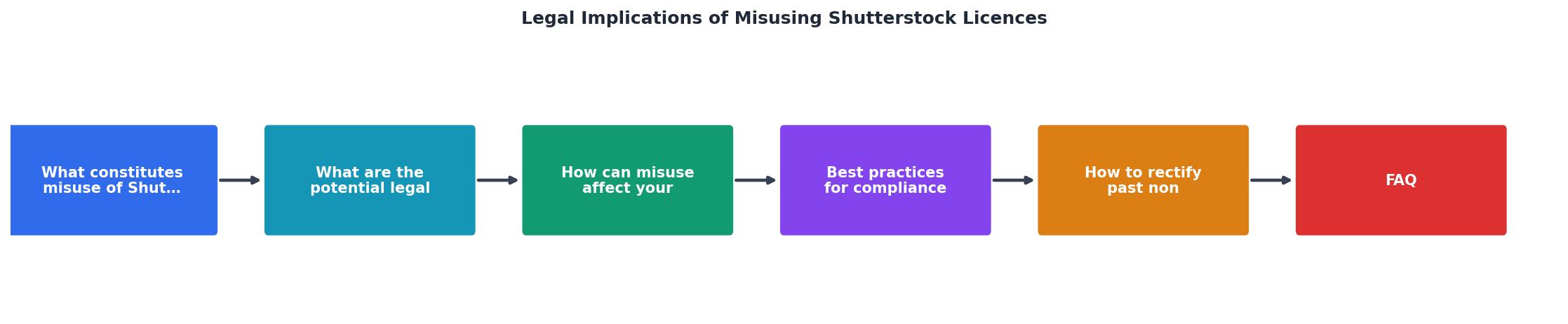
If you suspect past projects contain improperly licensed Shutterstock images, act now. Waiting until a claim arrives puts you in the weakest possible negotiating position. Follow these steps:
- Audit every active project. List all projects currently live (websites, social media, print materials, client deliverables). Identify every Shutterstock image in each project.
- Check your download history. Log into Shutterstock and review your complete download history. Match each image in your audit to a download record and licence certificate.
- Identify gaps. Flag any image where you cannot find a matching licence, where the licence type does not cover the actual usage, or where the image is marked editorial but used commercially.
- Replace or re-licence problem images. For images used beyond the Standard Licence scope, purchase an Enhanced Licence. For editorial images used commercially, replace them with properly licensed alternatives immediately.
- Download all licence certificates. For every image that checks out, download the licence certificate and store it in your project archive. Use a consistent naming convention.
- Notify affected clients. If you replaced images in client deliverables, inform the client and provide updated files. Transparency builds trust, even when the news is uncomfortable.
- Document everything. Keep a written record of your audit: what you found, what you fixed, and when. This documentation becomes your defence if a past issue surfaces later.
| Before Audit | After Audit |
|---|---|
| No central licence records | Every image matched to a certificate |
| Unknown exposure to claims | Clear risk assessment per project |
| Reactive (wait for a letter) | Proactive (issues resolved in advance) |
| Client trust at risk | Documented compliance builds confidence |
| Hours spent per dispute | Minutes spent per quarterly review |
Shutterstock Licence Compliance Checklist
Your progress is saved automatically in your browser.
FAQ
Frequently Asked Questions
Additional Resources
- How can I get maximum legal protection when using stock ... - General liability and risk: risk and liability are low when you use a large stock photo company because they usually handle the copyright and ...
- Shutterstock Terms of Service & License Agreements - The following is a legal agreement between you or the employer or other entity on whose behalf you are entering into this agreement and Shutterstock.
- Legal Advice on Shutterstock Licensing and Stock Photo ... - Legal claims can include breach of contract against the user and potential copyright infringement if usage exceeds the license. Defamation ...
Need to Download Your Licences?
Save hours of manual work. We download all your stock photo licence certificates for you.
Get Started“Thanks to LicenceDownloader.com, I was able to download more than 1,000 Freepik licences and receive them all at once via ZIP.”
Marlon Mainardy