Responding to Copyright Claims with Valid Licences
You bought the image. You paid for the licence. And now a scary email lands in your inbox claiming you owe hundreds or thousands of dollars for copyright infringement. The good news is that a valid licence is your best shield, but only if you know how to present it.

You bought the image. You paid for the licence. And now a scary email lands in your inbox claiming you owe hundreds or thousands of dollars for copyright infringement. The good news is that a valid licence is your best shield, but only if you know how to present it. This guide walks you through the exact steps to respond to a copyright claim when you already have the right to use the image.
Photo by Vitaly Gariev from Pexels
TL;DR:- A valid stock media licence is a complete legal defence against copyright claims for that specific use.
- Respond promptly with organized proof: the licence certificate, purchase receipt, and a screenshot showing the asset in your account.
- If the claimant ignores your documentation or escalates, consult a lawyer before paying anything.
The short answer
If you hold a valid licence that covers the way you used the image, you do not owe the claimant money. Full stop. The licence is a contract between you and the stock platform granting specific usage rights. Your job is to prove that contract exists and that your usage falls within its terms. That means gathering the right documents, writing a clear response, and knowing when to escalate. Most copyright claim letters sent to small businesses are resolved once proper licence proof is presented. The claimant (or their automated system) often moves on once they see legitimate documentation.
Common copyright claim scenarios
Not every claim arrives the same way. Understanding the type of claim helps you craft the right response.
- Automated takedown notices on platforms like Meta, Amazon, or Etsy. An algorithm or rights holder flags your listing or ad. You receive a notification with a form to submit a counter-notice.
- Demand letters from law firms representing photographers or stock agencies. These typically cite a specific image, a URL where it appeared, and a settlement amount.
- DMCA takedown requests sent to your web host. Your host may temporarily remove the content and forward the notice to you.
- Direct emails from photographers or agencies claiming you used their work without permission.
Gather your licence documentation
Before you write a single word to the claimant, collect every piece of evidence that ties you to the licensed asset. Here is what you need:
- Licence certificate or agreement from the stock platform (Freepik, Shutterstock, Adobe Stock, Canva, iStock, Envato, etc.). This is the document that states what you are allowed to do with the file.
- Purchase receipt or invoice showing the date, amount paid, and your account details.
- Download history screenshot from your account dashboard proving you downloaded that specific file.
- Subscription confirmation if the image was part of a plan (Canva Pro, Freepik Premium, Envato Elements).
- URL or screenshot of your usage showing how and where the image appeared.
licence-certificate-shutterstock-12345.pdf, receipt-2025-06-15.pdf, and so on.
If you use multiple stock platforms, tracking down the right licence can take hours. Tools like Licence Downloader let you bulk-export licence certificates from platforms like Freepik, Shutterstock, Adobe Stock, and Canva in minutes, so you always have audit-ready proof before a claim even arrives.
Here is an example of what a well-organized licence proof folder might look like for a typical small business handling a claim:
📁 Claim Response Folder, Example
Respond to the claimant

Once your documentation is ready, write a clear, professional response. Keep emotion out of it. Here is the process at a glance:
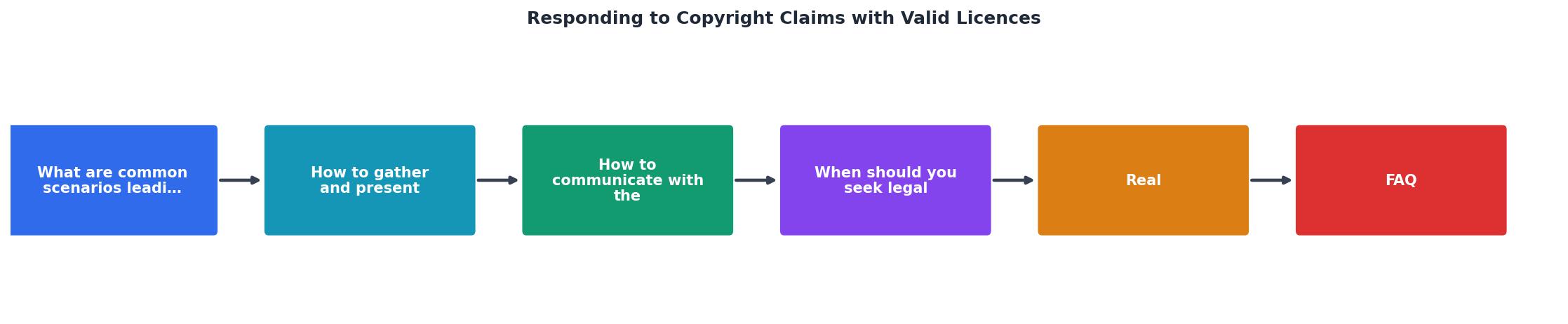
Follow these steps, matching the short labels in the diagram:
- Acknowledge the claim. Confirm you received the notice and identify the specific image or asset in question.
- State your licence. Clearly say you hold a valid licence for the asset and name the platform and licence type (e.g., "Freepik Premium licence, commercial use").
- Attach proof. Include the licence certificate, receipt, and download history as attachments or links.
- Describe your usage. Explain where and how the image was used, and confirm it falls within the licence terms.
- Request withdrawal. Politely ask the claimant to withdraw the claim or confirm the matter is resolved.
- Set a deadline. Give a reasonable timeframe (14 business days) for a response before you consider the matter closed.
| Ignoring the Claim | Responding with Proof |
|---|---|
| Content removed by platform | Content stays live |
| Default judgment risk | Claim withdrawn |
| Escalation to legal action | Matter closed quickly |
| Stress and uncertainty | Peace of mind |
When to get legal advice
Most claims resolve after you present valid licence proof. But some situations call for a lawyer:
- The claimant rejects your licence and insists on payment despite clear documentation.
- The demand letter threatens court action within a short deadline (7 days or less).
- The claimed amount is significant (over $1,000 or more than your comfort level).
- You are unsure whether your usage actually falls within the licence terms (e.g., you used a standard licence for merchandise, which often requires an extended licence).
- The claim involves a platform takedown on Amazon, Etsy, or Meta that is costing you sales every day it remains active.
Real responses that worked
Scenario 1: Facebook ad flagged on Canva image. A bakery owner received a Meta notification that her Facebook ad was removed for copyright infringement. She logged into Canva, downloaded her licence certificate for the image, attached it to Meta's counter-notice form, and had the ad restored within 48 hours.
Scenario 2: Law firm demand letter for a Shutterstock photo. An online store owner got a letter demanding $750 for an image on his product page. He replied with his Shutterstock licence certificate, the invoice, and a screenshot of his download history. The law firm confirmed the matter was closed within 10 business days.
Scenario 3: DMCA notice to web host for a Freepik illustration. A small marketing consultancy found their website partially taken down after a DMCA notice. They submitted a counter-notice with their Freepik Premium licence proof. The host restored the content after the standard 10-day waiting period with no further action from the claimant.
In every case, the key was having the licence documentation ready and responding quickly.
Response letter template
Use this checklist to build your response. Adapt the wording to your situation, but cover every item.
Copyright Claim Response Checklist
Your progress is saved automatically in your browser.
Here is a simple template you can adapt:
Subject: Response to Copyright Claim, [Image ID / Reference Number]
Dear [Claimant Name / Law Firm],
I am writing in response to your notice dated [date] regarding the image [description or ID] appearing at [URL].
I hold a valid licence for this asset, obtained through [Platform Name] under my account [account email or ID]. The licence type is [Standard / Extended / Premium subscription], which permits [commercial use / the specific use in question].
Please find attached:
1. Licence certificate (PDF)
2. Purchase receipt / invoice
3. Download history screenshot
My usage of this image is fully within the terms of the licence agreement. I respectfully request that you withdraw this claim and confirm in writing that the matter is resolved.
If I do not receive a response within 14 business days, I will consider this matter closed.
Sincerely,
[Your Name, Business Name, Contact Information]
FAQ
Frequently Asked Questions
Have you ever received a copyright claim for an image you knew was properly licensed? Share how you handled it in the comments.
Additional Resources
- Responding to an Infringement Claim - Only the copyright owner or someone who has an exclusive license to the copyright can bring an infringement claim.
- Copyright Infringement: What It Is and How to Respond - If the claim is valid, remove the material promptly, negotiate a settlement or licensing arrangement, and document the resolution.
- How to respond to a copyright infringement claim - How should I respond to a copyright infringement claim?I have received a demand letter that is significantly higher than what seems reasonable. They are ...
Need to Download Your Licences?
Save hours of manual work. We download all your stock photo licence certificates for you.
Get Started“Thanks to LicenceDownloader.com, I was able to download more than 1,000 Freepik licences and receive them all at once via ZIP.”
Marlon Mainardy